
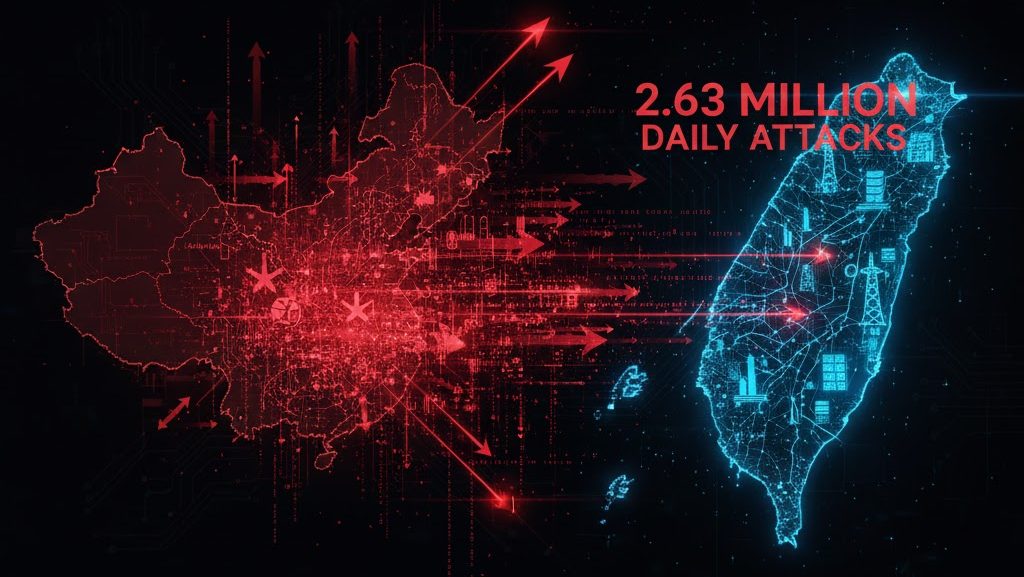
Taiwan’s National Security Bureau (NSB) released a sobering report on January 4, revealing that Chinese-linked cyberattacks targeting the island’s critical infrastructure averaged 2.63 million per day throughout 2025—a 6% increase from 2024 and a staggering 113% jump since tracking began in 2023.
These state-sponsored operations, often synchronized with PLA military drills, represent a deliberate “hybrid warfare” strategy aimed at disrupting or paralyzing key sectors like energy, healthcare, and semiconductors.
Chinese threat actors relied on four core methods in 2025:
Notable groups included BlackTech, Flax Typhoon, Mustang Panda, APT41, and UNC3886, focusing on energy, healthcare, communications, government, and high-tech sectors.
Ransomware hit hospitals hard—at least 20 major deployments identified, with stolen data sold on dark web forums.
This escalation underscores China’s integration of cyber operations into geopolitical coercion:
As tensions rise into 2026, expect continued—or intensified—gray-zone aggression.
To counter similar state-level threats:
Taiwan’s resilience—bolstered by joint defenses and international intel sharing—offers a model, but no sector is immune.
This NSB disclosure is a wake-up call: state-sponsored cyber armies are scaling up, and 2026 could bring even more sophisticated hybrid campaigns.
“On average, China’s cyber army launched 2.63 million intrusion attempts per day targeting Taiwan’s critical infrastructure (CI) across nine key sectors.” Taiwan National Security Bureau, 2025 Report
Taiwan’s National Security Bureau (NSB) released a sobering report on January 4, revealing that Chinese-linked cyberattacks targeting the island’s critical infrastructure averaged 2.63 million per day throughout 2025—a 6% increase from 2024 and a staggering 113% jump since tracking began in 2023.
These state-sponsored operations, often synchronized with PLA military drills, represent a deliberate “hybrid warfare” strategy aimed at disrupting or paralyzing key sectors like energy, healthcare, and semiconductors.
Chinese threat actors relied on four core methods in 2025:
Notable groups included BlackTech, Flax Typhoon, Mustang Panda, APT41, and UNC3886, focusing on energy, healthcare, communications, government, and high-tech sectors.
Ransomware hit hospitals hard—at least 20 major deployments identified, with stolen data sold on dark web forums.
This escalation underscores China’s integration of cyber operations into geopolitical coercion:
As tensions rise into 2026, expect continued—or intensified—gray-zone aggression.
To counter similar state-level threats:
Taiwan’s resilience—bolstered by joint defenses and international intel sharing—offers a model, but no sector is immune.
This NSB disclosure is a wake-up call: state-sponsored cyber armies are scaling up, and 2026 could bring even more sophisticated hybrid campaigns.
“On average, China’s cyber army launched 2.63 million intrusion attempts per day targeting Taiwan’s critical infrastructure (CI) across nine key sectors.” Taiwan National Security Bureau, 2025 Report