

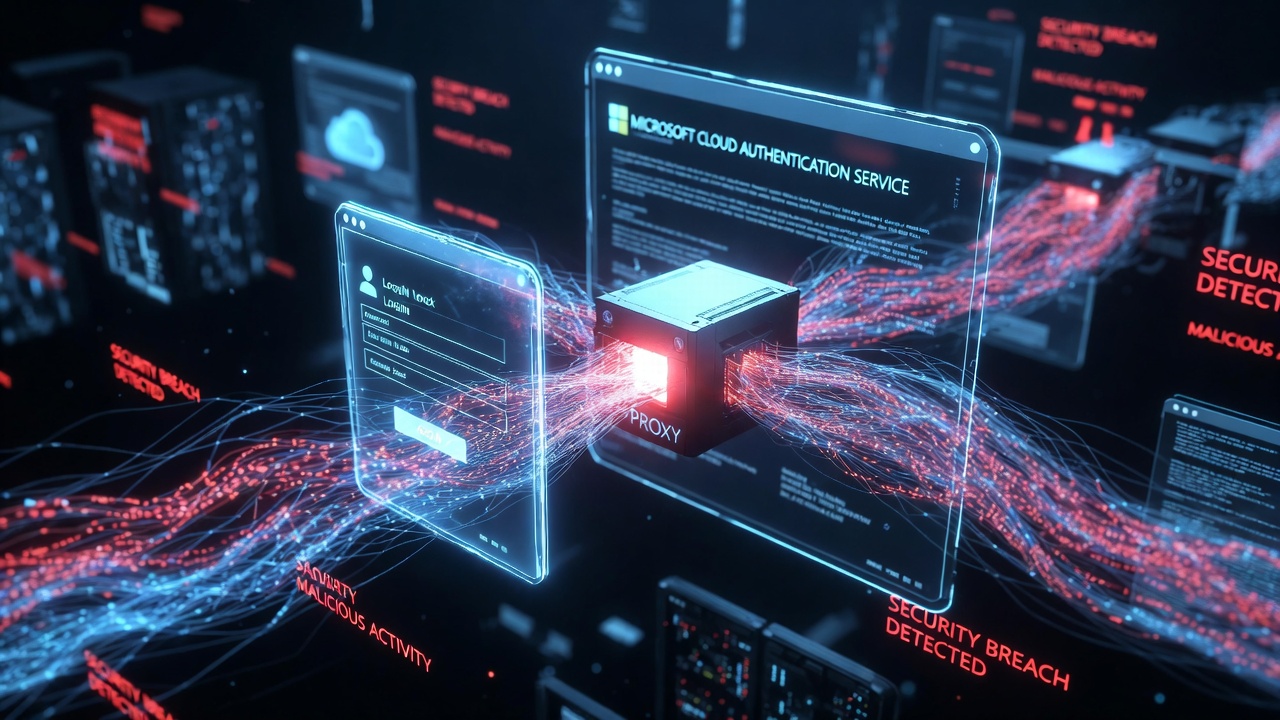
Adversary-in-the-Middle (AiTM) phishing has rapidly emerged as one of the most effective MFA-bypass techniques in modern identity attacks.
Unlike credential phishing, AiTM operates as a real-time reverse proxy, silently capturing credentials, MFA responses, and — most critically — authenticated session cookies and OAuth tokens. The attacker then reuses the stolen session without ever triggering MFA again.
This technique is now heavily featured in Credential Abuse campaigns and frequently serves as the initial access vector leading to rapid ransomware breakout.
Three converging trends have accelerated AiTM adoption:
With >92% of enterprises now enforcing MFA on cloud identity platforms, attackers shifted focus from credential theft to session hijacking.
Turnkey frameworks such as Evilginx3, Modlishka, Tycoon2FA, and Mamba are now sold on underground markets for as little as $300–$1,200. These kits include built-in browser fingerprint spoofing, WebSocket relay for push-based MFA, and automatic cookie/token extraction.
Cloud identity (Microsoft Entra ID, Google Workspace, Okta) is now the control plane for most organizations. A single compromised admin session grants access to email, SaaS, cloud consoles, and backup systems — exactly the blast radius detailed in this week’s Weekly Threat Brief (Week Ending March 1, 2026).
Attacker registers a lookalike domain (e.g., login-microsoft365[.]com) and deploys an Evilginx3 or custom nginx reverse-proxy. The proxy transparently forwards traffic while injecting JavaScript to capture browser fingerprints and stripping security headers that could reveal the proxy.
Victim enters username/password → proxy logs them and forwards. MFA challenge (push, TOTP, SMS) is relayed in real time. Modern kits use WebSocket tunnels to keep the session alive even if the victim closes the tab.
After MFA success, the legitimate IdP issues .AspNetCore.Antiforgery, refresh_token, rtFa, or sessionid cookies. The proxy extracts them before they reach the victim’s browser. These tokens may remain valid for days or weeks depending on tenant policy and bypass all MFA controls.
Attacker replays the exact cookies + User-Agent + IP (via residential proxies) from a C2 server. Because the session is already authenticated, Conditional Access policies often treat the activity as legitimate. Many organizations still lack device-bound tokens or token-binding, making reuse trivial.
Security teams investigating suspected AiTM activity should watch for:
Individually these signals may appear benign, but when correlated across identity logs, SIEM telemetry, and endpoint data, they frequently reveal active session hijacking in progress. Proactive hunting using these IOCs can significantly shorten detection and response times.
AiTM is now the #1 initial access vector for:
AiTM phishing has fundamentally changed the identity threat landscape. Attackers no longer need to defeat MFA — they simply sit in the middle, let the legitimate user authenticate, and steal the resulting trusted session.
In 2026, the weakest link is no longer the password. It is the session token. Organizations that still rely on legacy MFA or lack robust session monitoring are effectively handing attackers persistent, MFA-proof access.
Move to phishing-resistant authentication now — or become the next headline in the Weekly Threat Brief.
This analysis draws from real-world threat intelligence, vendor research, and government guidance on AiTM phishing techniques, detection, and defenses.
These sources provide foundational insights into AiTM proxy mechanics, session token theft, BEC follow-on attacks, detection indicators, and the transition to phishing-resistant authentication.
If you find ByteVanguard useful, you can support the site and help keep the analysis independent.
Support the analysis