

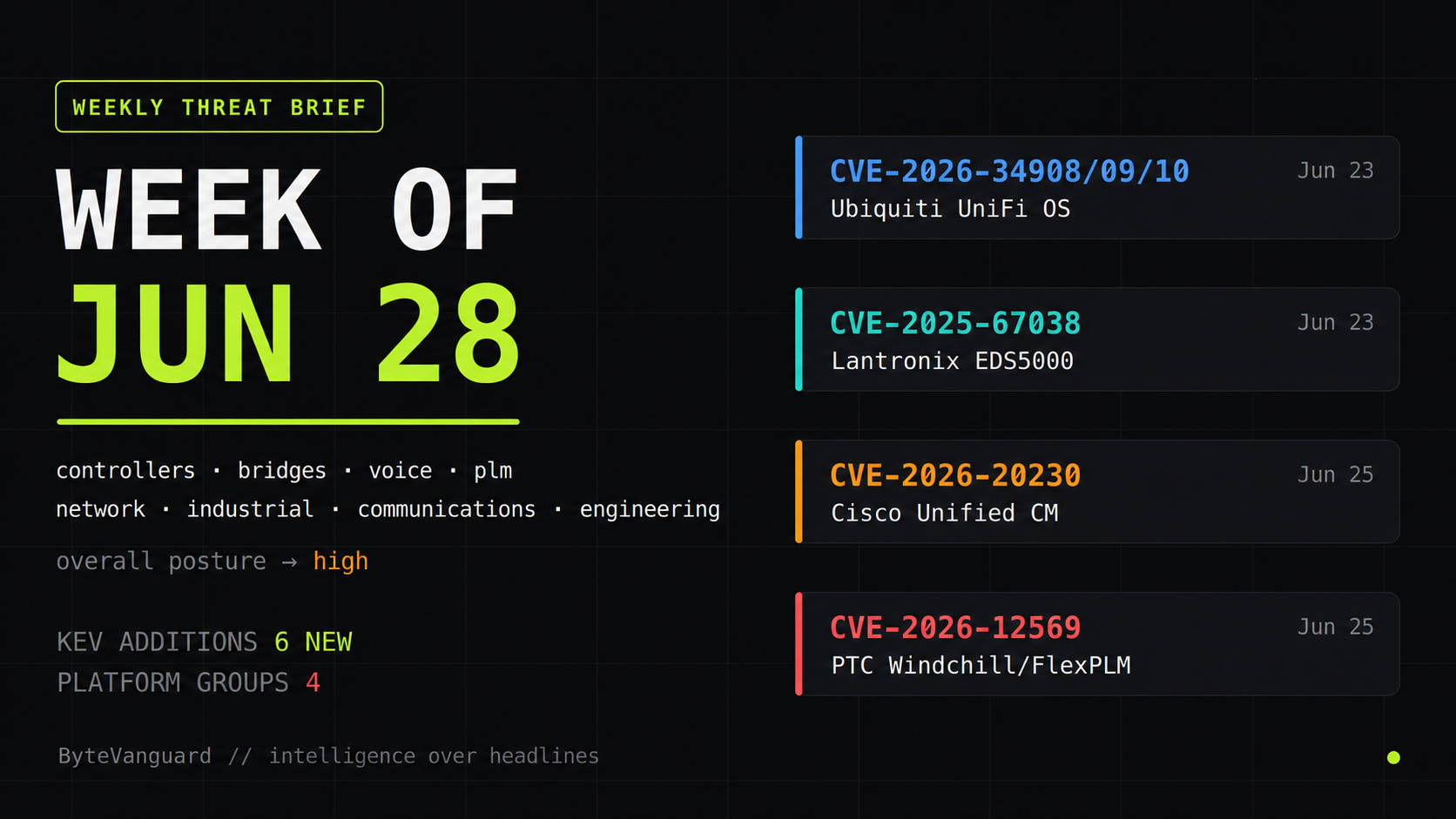
Week Ending: June 28, 2026 | Overall Risk Posture: High
The week ending June 28 was not defined by a broad flood of new KEV entries. It was defined by where the exploitation landed.
CISA added four vulnerabilities affecting Ubiquiti UniFi OS, Lantronix EDS5000 serial-to-Ethernet devices, Cisco Unified Communications Manager, and PTC Windchill/FlexPLM.
These systems sit in very different parts of the enterprise: network control, industrial connectivity, voice infrastructure, and engineering/product lifecycle workflows. But they share one important theme. They are trusted operational platforms. They are systems that manage other systems, connect sensitive environments, store valuable business data, or sit quietly inside the internal fabric of the organization.
This is why the week matters. The risk is not only that vulnerable software exists. The risk is what the vulnerable software is trusted to control, connect, or expose.
Threat at a Glance
| Threat Area | Key Issue | Why It Matters | Defender Priority |
|---|---|---|---|
| Network Control | Ubiquiti UniFi OS was added to KEV for CVE-2026-34910. | UniFi OS devices often manage gateways, switches, access points, cameras, and site infrastructure. | Update affected UniFi OS devices, review admin accounts, and check for unauthorized configuration changes. |
| Industrial Connectivity | Lantronix EDS5000 was added for CVE-2025-67038. | Serial-to-Ethernet devices often bridge legacy operational systems into modern IP networks. | Patch firmware, remove unnecessary exposure, and review network segmentation around OT-adjacent assets. |
| Voice Infrastructure | Cisco Unified Communications Manager was added for CVE-2026-20230. | Voice systems are trusted internal services and often integrate with identity, directories, and endpoint workflows. | Patch Unified CM, verify WebDialer exposure, and inspect for abnormal file or HTTP activity. |
| Engineering and PLM | PTC Windchill and FlexPLM were added for CVE-2026-12569. | PLM platforms hold product data, CAD files, bills of materials, supplier workflows, and sensitive IP. | Apply PTC remediations, hunt for web shells, and review exposed Windchill/FlexPLM instances for compromise. |
Active Exploitation and Immediate Risk
-
Ubiquiti UniFi OS kept network controllers in the spotlight
CISA added CVE-2026-34910, affecting Ubiquiti UniFi OS.
The vulnerability involves improper input validation that can allow command injection by a malicious actor with network access. CISA added the flaw to KEV on June 23, with a June 26 remediation deadline.
UniFi OS is not just another appliance interface. In many small-business, branch, MSP, and distributed environments, it acts as a central controller for network infrastructure. It may manage gateways, switching, wireless access, cameras, access systems, and site-level device configuration. A compromise of that layer can give an attacker more than access to one host. It can give them visibility and influence over the environment around it.
Defenders should apply the relevant UniFi OS updates, review administrative users, check whether SSH or remote access settings changed, inspect cloud access settings, and look for unexpected configuration changes. Any unexplained new admin account, credential change, device adoption event, or outbound connection from a controller should be treated as high-signal. -
Lantronix EDS5000 showed why small infrastructure bridges can carry large risk
CISA added CVE-2025-67038, affecting Lantronix EDS5000 devices.
The vulnerability is a code injection issue affecting serial-to-Ethernet infrastructure. CISA added it to KEV on June 23, with a June 26 remediation deadline. Reporting from Forescout’s Vedere Labs also highlighted a faster exploitation pattern: attackers were observed exploiting the flaw after a patch was available but before broad public disclosure, suggesting that patch diffing or other early-reverse-engineering behavior may have played a role.
That timeline matters. Defenders often wait for public exploit code, proof-of-concept writeups, or heavy scanning before moving a device to the front of the queue. For operational technology and infrastructure bridge devices, that delay is increasingly dangerous.
Serial-to-Ethernet devices are easy to overlook because they are not glamorous assets. But they may connect legacy industrial systems, facility equipment, utilities, transportation components, or other operational environments to routable IP networks. If exposed or poorly segmented, a small device can become a practical bridge into a much more sensitive environment.
Defenders should identify Lantronix EDS5000 deployments, confirm firmware status, remove unnecessary internet or broad internal exposure, and check whether these devices sit near sensitive OT or facility networks. They should also review failed logins, unusual commands, new outbound connections, and traffic from these devices into networks they should not normally reach. -
Cisco Unified CM brought voice infrastructure back into the exploitation conversation
CISA added CVE-2026-20230, affecting Cisco Unified Communications Manager and Unified CM Session Management Edition.
Cisco describes the issue as a server-side request forgery vulnerability caused by improper input validation for specific HTTP requests. An unauthenticated remote attacker could exploit the flaw by sending a crafted HTTP request to an affected device. Cisco’s advisory notes that exploitation depends on the WebDialer service being enabled and that there are no workarounds available.
CISA added the vulnerability to KEV on June 25, with a June 28 remediation deadline. The important detail is not only the vulnerability class. It is the platform role. Unified CM is often treated as internal communications plumbing. But it can sit close to directories, endpoints, call routing, identity integrations, and trusted internal service paths.
Voice infrastructure is frequently less visible to security teams than VPNs, firewalls, or identity providers. That visibility gap can make it attractive. Attackers do not need the system to be fashionable. They need it to be trusted, reachable, and poorly watched.
Defenders should patch affected Unified CM deployments, determine whether WebDialer is enabled, restrict access to the management plane, and review system logs for suspicious HTTP requests, unexpected file changes, abnormal outbound connections, service restarts, or administrative activity outside normal maintenance windows. -
PTC Windchill and FlexPLM made engineering data an active exploitation target
CISA added CVE-2026-12569, affecting PTC Windchill and FlexPLM.
PTC describes the issue as a critical vulnerability that could allow an unauthorized user to execute code remotely. The vulnerability affects Windchill and FlexPLM environments, and PTC has published remediation steps, patches, and indicators of compromise. CISA added the flaw to KEV on June 25, with a June 28 remediation deadline.
This is one of the most important items of the week because Windchill and FlexPLM are not ordinary application servers. They are product lifecycle and engineering platforms. They may hold CAD files, bills of materials, change records, supplier workflows, manufacturing context, and intellectual property that directly reflects how a company designs and builds.
PTC’s advisory included indicators tied to suspicious JSP web shells, attacker infrastructure, and suspicious request patterns. That moves this from a patch-only issue into a compromise-review issue. If a Windchill or FlexPLM system was reachable during the exposure window, defenders should not assume the update alone answers the risk.
Teams should apply PTC’s remediations immediately, scan for unexpected JSP files, review POST requests to suspicious Windchill login paths, check for unusual headers, inspect temporary files, and look for signs of data staging or exfiltration. For PLM systems, the incident question is not only whether the server was touched. It is whether engineering data was accessed.
Common Failure Patterns
-
Trusted platforms are still treated like ordinary applications
UniFi OS, Cisco Unified CM, and PTC Windchill all show the same problem from different angles. A vulnerability in a management or operational platform can matter more than the same class of bug on a low-value internal system because the affected platform already has trust. -
Small infrastructure devices often escape asset discipline
Lantronix EDS5000 devices are the kind of systems that can remain in service for years with limited visibility. They may not be owned by the same team that manages servers, endpoints, or cloud assets, yet they can still provide access to sensitive environments. -
Internal-only assumptions create blind spots
Voice systems, network controllers, PLM platforms, and serial bridges are often assumed to be safe because they are internal. But internal reachability is not the same as safety. Once an attacker has a foothold, internal management interfaces become attractive next steps. -
Patching is separated from compromise review
Several of this week’s vulnerabilities require more than version updates. If a platform was exposed before remediation, defenders should ask whether it was abused before the patch was applied. -
Ownership slows response
UniFi may belong to network operations. Lantronix may belong to OT or facilities. Cisco Unified CM may belong to telecom. Windchill may belong to engineering IT. Attackers do not care which team owns the system. Once exploitation is confirmed, ownership gaps become risk. -
Control systems are monitored less aggressively than endpoints
Endpoint detection may be strong while controllers, appliances, bridges, and PLM servers receive weaker logging and alerting. That imbalance creates exactly the kind of quiet infrastructure foothold attackers want.
Defender Priorities
-
Patch UniFi OS and review controller integrity
Update affected UniFi OS devices according to Ubiquiti guidance. Review administrative users, SSH settings, cloud access, device adoption activity, configuration changes, and unexpected outbound traffic from controllers. -
Segment network management platforms
UniFi controllers and similar management systems should not be reachable from broad user VLANs, guest networks, or untrusted internal segments. Restrict access to administrative networks and enforce strong authentication. -
Identify Lantronix EDS5000 devices and remove unnecessary exposure
Confirm firmware status, inventory all deployed devices, and determine whether they sit near OT, facility, industrial, or legacy serial environments. Remove public exposure and restrict management access. -
Review industrial bridge traffic
Look for unusual outbound connections, authentication attempts, configuration changes, and traffic from serial-to-Ethernet devices into networks they should not normally reach. -
Patch Cisco Unified CM and verify WebDialer status
Apply Cisco’s fixed software for CVE-2026-20230. Determine whether WebDialer is enabled and whether any Unified CM services are reachable beyond intended administrative networks. -
Inspect Cisco Unified CM for abnormal behavior
Review logs for suspicious HTTP requests, unexpected file writes, unusual service restarts, configuration changes, and outbound connections from Unified CM servers. -
Apply PTC Windchill and FlexPLM remediations immediately
Follow PTC’s advisory guidance for CVE-2026-12569. Prioritize internet-facing or partner-facing deployments, but do not ignore internal systems that may be reachable from compromised user networks. -
Hunt for Windchill web shell indicators
Search for unexpected JSP files, POST requests to suspicious Windchill login paths, unusual headers, known attacker infrastructure, temporary files, and signs of file listing or data staging. -
Use KEV as an incident-response trigger
KEV should not only trigger patching. For high-trust systems, it should trigger a targeted review of whether exploitation happened before remediation.
Signals to Watch
-
Controller exploitation is becoming a recurring theme
UniFi OS continues the broader pattern of attackers targeting systems that manage infrastructure rather than only endpoints inside that infrastructure. -
OT-adjacent devices remain under-monitored
Lantronix EDS5000 highlights a recurring risk in operational environments: small connectivity devices can become overlooked paths into sensitive networks. -
Voice infrastructure should not be excluded from vulnerability priority queues
Cisco Unified CM shows that communication platforms deserve the same urgency as other trusted internal services when active exploitation is confirmed. -
Engineering platforms are attractive targets for IP access
PTC Windchill and FlexPLM matter because the data stored there can be strategically valuable. Product designs, supplier workflows, and manufacturing context can be more valuable than ordinary business documents. -
Three-day remediation deadlines are becoming the new pressure point
BOD 26-04 has changed the operational rhythm for the highest-risk exploited vulnerabilities. The organizations that wait for traditional monthly patch cycles will increasingly fall behind the exploitation timeline. -
Patch status and compromise status are different questions
A system can be patched today and still have been compromised yesterday. This is especially important for systems with administrative trust, internal reach, or sensitive data.
Weekly Pulse
The week ending June 28 showed exploitation pressure against trusted operational platforms rather than a single vulnerability class.
Ubiquiti UniFi OS represented network-controller risk. Lantronix EDS5000 represented industrial bridge risk. Cisco Unified CM represented voice-infrastructure risk. PTC Windchill and FlexPLM represented engineering and product-data risk.
The common thread is trust. These systems are trusted to manage networks, connect legacy devices, route communications, and store engineering workflows. That trust is exactly why attackers care about them.
This was not the loudest KEV week of the year, but it was a strategically important one. It showed that exploitation continues to move toward platforms that sit close to access, operations, visibility, and business-critical data.
Bottom Line
This week’s CISA KEV changes were not about one vendor or one exploit family. They were about trusted systems becoming attack surfaces.
For defenders, the immediate priority is clear: update UniFi OS, patch Lantronix EDS5000 devices, remediate Cisco Unified CM, and apply PTC Windchill/FlexPLM fixes and compromise checks.
But the larger lesson is more important than the patch list. When a vulnerable product manages networks, bridges operational systems, routes communications, or stores engineering data, remediation should not stop at version control.
Defenders should ask what the vulnerable system could control, what it could expose, what it could connect, and what trust relationships it could give an attacker.
The risk is not only what is vulnerable. The risk is what the vulnerable system is trusted to do.
Sources
- CISA — Known Exploited Vulnerabilities Catalog
- Ubiquiti — Security Advisory Bulletin 064
- NVD — CVE-2026-34910 Ubiquiti UniFi OS
- ITPro — Lantronix exploitation and Forescout Vedere Labs findings
- NVD — CVE-2025-67038 Lantronix EDS5000
- Cisco — Unified Communications Manager Server-Side Request Forgery Vulnerability
- NVD — CVE-2026-20230 Cisco Unified Communications Manager
- PTC — Windchill and FlexPLM CVE-2026-12569 Advisory
- PTC — CS473270 Windchill and FlexPLM Remediation Details
- NVD — CVE-2026-12569 PTC Windchill and FlexPLM
- CISA — BOD 26-04: Prioritizing Security Updates Based on Risk
- CISA — BOD 26-04 Implementation Guidance
