

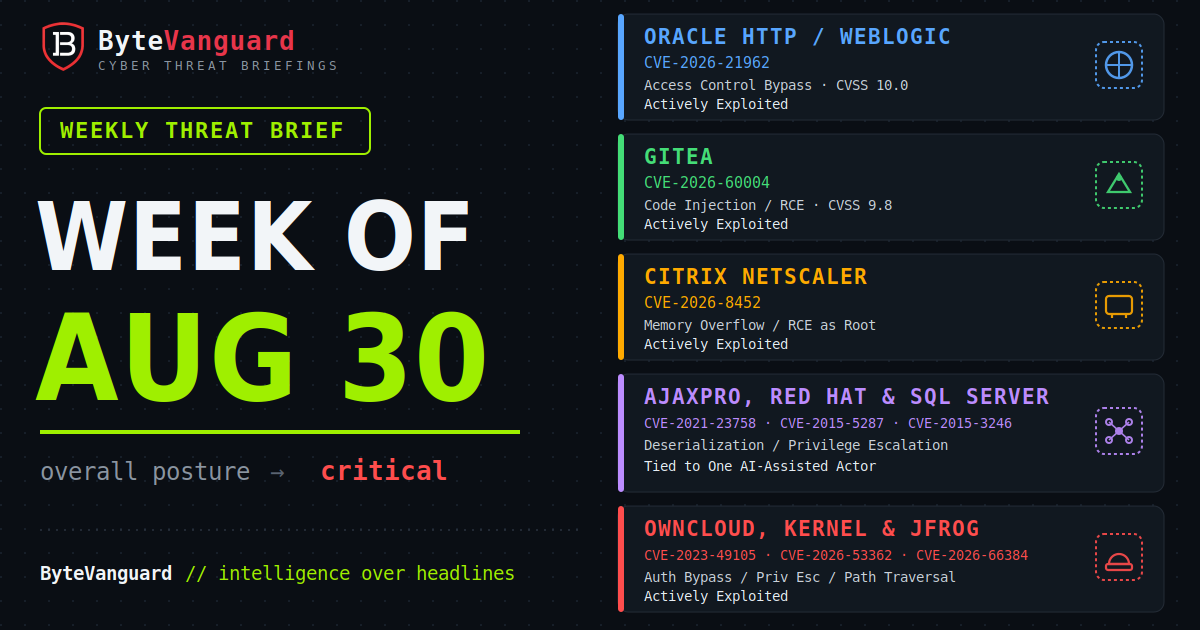
Week Ending: August 30, 2026 | Overall Risk Posture: Critical
CISA added eleven vulnerabilities to its Known Exploited Vulnerabilities catalog during the week ending August 30 — the heaviest single week ByteVanguard has tracked in recent months. The list spans a self-hosted Git platform, an Oracle web-tier component, a VPN appliance, an enterprise file-sync server, two Linux kernel bugs, and three flaws in software most defenders haven’t touched in years.
Read as a flat list, it looks scattershot. Read against the primary reporting behind each entry, a pattern holds: almost none of this week’s activity is new. What’s new is that CISA finally confirmed it. One flaw had been under attack since January. Another was mischaracterized by its own vendor for six weeks before independent researchers proved it was full remote code execution. A third traces directly to a documented AI-assisted crime group whose target list Cisco Talos published a week before the KEV entries landed.
This week’s signal is less about eleven individual CVEs than about the gap between confirmed exploitation and confirmed listing — a gap that ranged from days to the better part of a year.
Threat at a Glance
| Product | KEV | Why It Matters |
|---|---|---|
| Oracle HTTP Server / WebLogic Proxy Plug-in | CVE-2026-21962 | CVSS 10.0, unauthenticated. Independent researchers reported exploitation since January — about seven months before this KEV listing. |
| Gitea | CVE-2026-60004 | Self-hosted Git RCE via the diffpatch API; default open registration lets unauthenticated users reach it. |
| Citrix NetScaler ADC / Gateway | CVE-2026-8452 | Vendor called it denial-of-service; independent research proved unauthenticated RCE as root six weeks later. |
| Microsoft SQL Server | CVE-2019-1068 | Seven-year-old remote code execution flaw, newly confirmed under active exploitation. |
| Ajax.NET Professional (AjaxPro) | CVE-2021-23758 | Deserialization RCE weaponized by UAT-10147 in a documented AI-assisted campaign. |
| Linux Kernel | CVE-2022-0995 | Out-of-bounds write used for local privilege escalation; part of the same campaign. |
| Red Hat ABRT / Libuser | CVE-2015-5287 / CVE-2015-3246 | Two eleven-year-old privilege-escalation and race-condition bugs, still functional against unpatched Linux hosts. |
| ownCloud | CVE-2023-49105 | CVSS 9.8. A pre-signed URL flaw lets an attacker read or alter another user’s files without a password. |
| Linux Kernel (IPv6) | CVE-2026-53362 | Local privilege escalation via malformed fragmented IPv6 packets. |
| JFrog Artifactory | CVE-2026-66384 | Path traversal lets an authenticated user write outside the intended Docker cache path. |
The Oracle Bug That Took Seven Months to Confirm
-
CVSS 10.0, patched in January, listed in August
CVE-2026-21962 is the most severe entry on this week’s list — unauthenticated, reachable over plain HTTP, affecting the Oracle WebLogic Server Proxy Plug-in for Apache HTTP Server and IIS. Oracle patched it in the January 2026 Critical Patch Update. CISA didn’t add it to KEV until August 24.
The gap in between is the story. Threat-intelligence firm CloudSEK reported honeypot activity against the flaw starting January 22, immediately after a proof-of-concept went public. FalconFeeds referenced ongoing exploitation in June. SOCRadar reported in July that the CVE was one of several vulnerabilities a China-linked actor was using against government targets — a full month before CISA’s listing and its three-day federal remediation deadline arrived. -
What the KEV entry does and doesn’t confirm
None of this means every organization running the affected proxy component was breached; the flaw’s scope is narrower than “every WebLogic server,” and CISA’s KEV notice doesn’t attribute the exploitation it confirmed to any specific campaign. What it does mean is that KEV inclusion, in this case, lagged public reporting of active exploitation by roughly seven months.
Sourcing note: CISA’s KEV entry confirms exploitation occurred; it does not confirm which actor, campaign, or timeframe CloudSEK, FalconFeeds, and SOCRadar were separately describing. Treat those as related public reporting on the same vulnerability, not as CISA’s own attribution.
Citrix NetScaler: Wrong Severity, Right Vulnerability
Citrix disclosed CVE-2026-8452 on June 30 and shipped a same-day patch, describing it as a memory-overflow bug leading to “unpredictable or erroneous behavior and denial of service.” On that description, most security teams made a defensible call: patch it on the normal cycle. It’s a crash bug on an edge appliance, not an emergency.
On August 14, watchTowr Labs published a technical analysis showing the same flaw actually delivers unauthenticated remote code execution as root on any appliance configured as a Gateway (SSL VPN, ICA Proxy, CVPN, RDP Proxy) or an AAA virtual server. Exploitation followed within days. Threat-intelligence firms Previdian and Defused both reported attackers deploying web shells named x.php and z.php to the NetScaler management interface’s theme directory, then running basic discovery commands to confirm which account the shell inherited. Previdian later counted 36 exploitation attempts from 12 distinct IP addresses across ten countries over a 12-day window. CISA added the flaw to KEV on August 26 with a three-day federal deadline.
The lesson isn’t that Citrix lied — the vendor’s own severity assessment was made before anyone had demonstrated the RCE path. It’s that a vendor’s stated impact is a starting hypothesis, not a ceiling. Any internet-facing appliance patched for “denial of service” deserves a second look when independent researchers revisit it months later.
One Campaign, Six KEV Entries
Five of this week’s additions — CVE-2021-23758 (AjaxPro), CVE-2022-0995 (Linux Kernel), CVE-2015-5287 (Red Hat ABRT), and CVE-2015-3246 (Red Hat Libuser), plus CVE-2019-1068 (Microsoft SQL Server) in the same August 26 batch — read as an odd assortment of legacy bugs. They aren’t random. Four of them trace directly to a Cisco Talos disclosure, published six days earlier, describing a Chinese-speaking financially motivated group Talos tracks as UAT-10147.
Talos found the group had exposed an operational download server, recovering a target list of roughly 170,000 URLs and AI-generated exploitation documentation — including a nine-section ViewState exploitation guide and companion Python scripts. UAT-10147 gains initial access to internet-facing Windows and Linux web servers using publicly disclosed vulnerabilities in Zimbra, Nacos, Telerik UI, AjaxPro, and ASP.NET environments, then chains in Linux privilege-escalation bugs — some, like CVE-2010-3904, sixteen years old — to gain root. Post-compromise, the group deploys BadIIS for SEO fraud, a custom cross-platform backdoor called SPECTRE with BYOVD capabilities, and exfiltrates data through a legitimate cloud configuration-management service to blend with normal administrative traffic. Talos also documented the actor using AI tooling — including logs from coding assistants — for exploit refinement, reconnaissance, and troubleshooting during live intrusions, not just for writing code offline.
None of the individual CVEs in this cluster are new or exotic. What’s new is that a single, well-documented, currently active campaign explains why CISA suddenly cared about a 2015 Red Hat race condition and an eleven-year-old privilege-escalation bug in the same week. If your environment still runs AjaxPro, unpatched Zimbra, Nacos, or Telerik UI for ASP.NET AJAX — and legacy Red Hat or general-purpose Linux hosts behind them — treat this cluster as a single incident-response question, not five separate patch tickets.
Gitea: Patched in July, Mining Crypto by Late August
-
Default settings turned into the attack path
CVE-2026-60004 is this week’s fastest-moving story. Gitea shipped a fix in version 1.27.1 on July 27 after researcher Shai Rod reported a code-injection flaw in the platform’s diffpatch API: an attacker with repository write access can submit a malicious patch that plants an executable Git hook, running arbitrary shell commands as the Gitea service account. Because Gitea enables self-registration by default, “repository write access” doesn’t require a stolen credential — an unauthenticated visitor can create an account, spin up a repository, and reach the vulnerable endpoint on their own. -
From patch to cryptominer in under a month
Exploitation surfaced within weeks. One incident report described a compromised self-hosted instance repurposed to run cryptocurrency-mining software. CISA added the flaw to KEV on August 25 with a three-day federal deadline. Shadowserver’s scans found more than 8,300 internet-exposed Gitea instances still vulnerable as of August 27.
Immediate action: Any self-hosted Gitea instance should be upgraded to 1.27.1 or later now. If the instance ran with open registration enabled and internet exposure during the exploitation window, treat it as a suspected compromise, not a routine patch: check for unexpected Git hooks, unfamiliar repositories or accounts, and mining processes, rather than closing the ticket once the version number changes.
The Lag Is the Signal
Four stories, four different gaps between confirmed exploitation and confirmed KEV listing: roughly seven months for the Oracle flaw, about six weeks for Citrix once its real severity was understood, six days for the UAT-10147 cluster after Talos published, and under a month for Gitea from patch to miner deployment. None of that variance is about how dangerous each bug is. It’s about how quickly independent research, vendor disclosure, and CISA’s own confirmation process happened to align.
The practical takeaway for defenders: KEV is a confirmation ledger, not a detection feed. Waiting for a CVE to appear in the catalog before treating it as urgent means inheriting whatever lag existed between the first honeypot hit and CISA’s sign-off — and this week, that lag ranged from days to the better part of a year. Vendor advisories, watchTowr-style independent re-analysis, and threat-intel telemetry from firms like Previdian, Defused, and Shadowserver are consistently arriving before KEV does, not after.
Defender Priorities
-
Patch the three-day-deadline items first
Oracle HTTP Server/WebLogic Proxy Plug-in, Gitea, and Citrix NetScaler all carried federal three-day remediation windows this week — treat that as CISA’s own signal of urgency, independent of your usual patch cadence. -
Audit Gitea for open registration
If self-registration is enabled and the instance was internet-facing before the patch, investigate before you upgrade, not just after. -
Inventory legacy dependencies, not just legacy OS versions
AjaxPro, Zimbra, Nacos, and Telerik UI for ASP.NET AJAX are the specific initial-access vectors in the UAT-10147 campaign — search for them by name, not just by patch level. -
Re-read old “denial of service only” advisories with fresh eyes
The Citrix case shows a vendor’s original severity call can undersell a bug months later. Any internet-facing appliance advisory downplayed as DoS-only is worth revisiting if it hasn’t been re-examined recently. -
Don’t wait for KEV to confirm urgency
Where credible independent researchers or threat-intel vendors report active exploitation, act on that before the CISA entry lands — this week shows the gap can run to months.
Bottom Line
Eleven KEV additions in one week looks like a spike in new threats. It’s mostly a spike in confirmed old ones.
The Oracle flaw was exploited for seven months before CISA said so. The Citrix bug was misclassified by its own vendor for six weeks. The Red Hat and AjaxPro bugs are between four and eleven years old, and only mattered this week because Cisco Talos happened to publish first.
Treat the KEV catalog as a lagging confirmation of what capable researchers and threat-intel firms already reported — and build your patch urgency around the earlier signal, not the later one.
Sources
- CISA — Known Exploited Vulnerabilities Catalog
- CISA — Alert: CVE-2026-21962 (Oracle HTTP Server / WebLogic Proxy Plug-in)
- SecurityWeek — CISA Warns of Exploited Oracle WebLogic Vulnerability
- Help Net Security — Previously Patched Citrix NetScaler Flaw Exploited in the Wild
- SecurityWeek — Recent Citrix NetScaler Vulnerability Exploited in the Wild
- Cisco Talos — UAT-10147: Chinese-Speaking Adversary Integrates Agentic AI Into Post-Compromise Operations
- The Hacker News — UAT-10147 Uses AI to Scale Server Attacks
- SecurityWeek — CISA Warns of Exploited Gitea Vulnerability
- BleepingComputer — Over 8,300 Gitea Servers Vulnerable to Code Execution Attacks
- CISA — Alert: Three Known Exploited Vulnerabilities Added, Aug 27 2026 (ownCloud, Linux Kernel, JFrog Artifactory)
- Security Affairs — CISA Adds ownCloud, Linux Kernel, and JFrog Artifactory Flaws to KEV
