Mastering Cloud Security: The Ultimate Azure Vulnerability Management Guide 2026

This Azure vulnerability management guide explores how the cloud security landscape has evolved significantly in 2026, with Microsoft Defender for Cloud now serving as the central hub for identifying, prioritizing, and remediating risks across hybrid and multi-cloud environments. Powered by integrated Microsoft Defender Vulnerability Management, the platform combines agentless and agent-based scanning to deliver real-time insights into software vulnerabilities, misconfigurations, and exploit paths.

This guide provides a comprehensive overview of Azure vulnerability management in 2026 — including key tools, common vulnerabilities, best practices, and actionable steps for organizations to strengthen their cloud posture. As Azure adoption accelerates amid rising threats like AI-enhanced attacks and supply-chain compromises, proactive Azure vulnerability management is no longer optional; it’s essential for maintaining resilience and compliance.

What is Azure Vulnerability Management in 2026?

Azure vulnerability management refers to the continuous process of discovering, assessing, prioritizing, and remediating security weaknesses in Azure workloads — spanning virtual machines (VMs), containers, serverless functions, databases, identity configurations, and more.

Under the shared responsibility model, Microsoft secures the underlying infrastructure, while customers own responsibility for patching guest OSes, securing configurations, and addressing application-layer risks. In 2026, this process leverages Microsoft Defender for Cloud as the unified platform, enriched with real-world exploitability data from sources like CISA KEV, MSRC, and reachability analysis.

Key advancements include:

  • Hybrid scanning (agentless for quick coverage, agent-based via Defender for Endpoint for deeper runtime visibility)
  • Reachability-based Software Composition Analysis (SCA) through native integrations like Endor Labs (GA in 2025/2026)
  • Expanded container and serverless support, including Chainguard/Wolfi image validation and external registries (JFrog Artifactory, Docker Hub)
  • Prioritization via attack path analysis and risk scoring tailored to business context, now unified under Exposure Management in the Defender portal

Effective management reduces breach windows by focusing remediation on exploitable issues first, rather than overwhelming teams with high-volume CVEs.

In 2026, Microsoft has further unified vulnerability insights under Exposure Management in the Defender portal, allowing security teams to view and prioritize risks with runtime context, AI-assisted remediation suggestions, and traceability from code repositories (GitHub/Azure DevOps) to deployed workloads. This reduces alert fatigue by focusing on truly exploitable issues rather than theoretical CVEs.

Azure Vulnerability Management Tools and Integrations in 2026

Microsoft provides native, integrated capabilities that form the backbone of Azure vulnerability management in Azure environments.

  • Microsoft Defender for Cloud — The central dashboard for posture management, vulnerability findings, and recommendations. Enable Defender for Servers Plan 2 to activate built-in scanning (agentless by default, with agent-based options via Defender for Endpoint integration).
  • Microsoft Defender Vulnerability Management — Powers scanning for software inventory, known vulnerabilities, and enriched insights (e.g., exploit code availability, KEV catalog matches). Supports Azure VMs, Arc-enabled on-premises, AWS/GCP connectors, and containers.
  • Azure Update Manager — Automates OS patching for Windows/Linux VMs, reducing manual effort on compute resources.
  • Microsoft Cloud Security Benchmark (MCSB) v2 — Provides posture and vulnerability management controls, including risk-based recommendations and Azure Policy enforcement for configurations.
  • Defender for Containers — Agentless registry scanning (ACR, external via Private Link including JFrog Artifactory/Docker Hub) and runtime protection for AKS clusters.
  • Azure Resource Graph — Query vulnerability data across subscriptions for custom reporting and automation.

Transitioning to the built-in Defender solution (from legacy Qualys/Tenable) is recommended for streamlined operations and better exploitability context.

Recent 2026 Enhancements in Microsoft Defender for Cloud

Microsoft continues to evolve Defender for Cloud with:

  • Native Endor Labs integration for reachability-based SCA, correlating code-level vulnerabilities to runtime workloads across Azure, AWS, and GCP.
  • Extended agentless scanning to external container registries (JFrog Artifactory, Docker Hub) and Chainguard/Wolfi images for secure base validation.
  • Serverless workload posture management (Azure Functions, Logic Apps) to close gaps in non-VM environments (GA elements from late 2025).
  • Tighter GitHub Advanced Security integration — Defender enhances (rather than replaces) dependency scanning results.
  • AI-assisted prioritization and remediation suggestions in Exposure Management, shortening remediation cycles.

These updates streamline operations for hybrid/multi-cloud setups, with automatic recommendations and Azure Policy enforcement reducing manual overhead.

Common Vulnerabilities and Misconfigurations in Azure

Despite robust tools, organizations continue to face recurring issues that expose environments to exploitation. Emerging 2026 threats include AI-enhanced exploit generation and sophisticated supply-chain attacks targeting open-source dependencies — making reachability analysis essential to filter noise and prioritize fixes that attackers can actually chain.

  • Unpatched VMs and Containers — Delayed OS/library updates leave known CVEs open; agentless scanning highlights these quickly, but remediation lags in large estates.
  • Identity and Entra ID Risks — Legacy token handling flaws and weak conditional access policies enable privilege escalation.
  • Storage Misconfigurations — Public Blob access, overly permissive keys, or exposed ports allow data exfiltration.
  • Container Registry Gaps — Vulnerable base images or unpatched dependencies in ACR/external registries; runtime exploits target running workloads.
  • Supply-Chain and SCA Issues — Open-source dependencies with known exploits; reachability analysis (via Endor Labs) now helps filter to truly impactful paths.
  • Serverless and API Exposures — Unauthenticated APIs or internet-exposed Functions/Logic Apps increase attack surface.

Prioritizing via exploit paths (e.g., in Defender portal’s Exposure Management) helps teams focus on critical risks over volume.

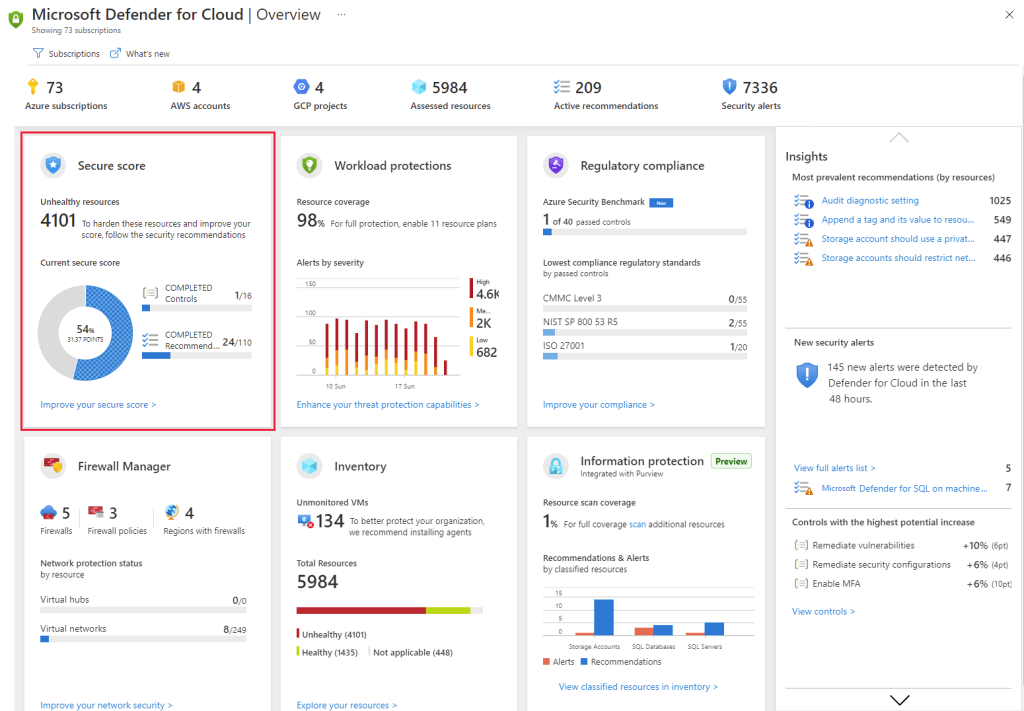
Management scan results showing prioritized findings in Microsoft Defender for Cloud

Best Practices for Effective Azure Vulnerability Management

Adopt these steps to build a mature program aligned with 2026 threats.

  • Enable Defender for Servers/Containers across all subscriptions for comprehensive coverage.
  • Use agentless scanning for rapid baseline assessments, supplemented by agent-based for runtime depth.
  • Prioritize findings with exploitability enrichment (KEV matches, attack paths, reachability via Endor Labs) and business context tagging.
  • Automate remediation via Azure Policy (DeployIfNotExists for configs) and Update Manager schedules.
  • Integrate with Azure Resource Graph for querying and alerting on high-risk items.
  • Conduct regular audits of identity (Entra ID MFA, least-privilege) and storage (disable public access).
  • For containers: Scan registries on push/pull (including external like JFrog/Docker Hub), enforce runtime protections in AKS.
  • Leverage Exposure Management campaigns for runtime-contextualized prioritization, reducing remediation time from days to hours via AI-driven suggestions.
  • Validate remediations through historical comparisons in Defender portal.
  • Complement native tools with third-party insights (e.g., SentinelOne for advanced endpoint correlation) where needed.

Consistency across hybrid environments — including Arc-onboarded machines — ensures no blind spots.

Action Steps for Organizations

To strengthen Azure vulnerability management immediately:

  • Audit current coverage — In Defender for Cloud, review Environment settings and enable missing Defender plans (especially Servers Plan 2).
  • Transition to built-in scanning — If using legacy solutions, migrate to Defender Vulnerability Management for better integration and insights.
  • Prioritize critical findings — Focus on recommendations tagged as “High Severity” or matching exploit paths; remediate within SLAs.
  • Automate patching and policies — Configure Azure Update Manager rings and Azure Policy initiatives for enforcement.
  • Monitor continuously — Set up alerts for new vulnerabilities, use Exposure Management dashboards, and query via Resource Graph.
  • Train teams — Emphasize shared responsibility and regular posture reviews to catch misconfigs early.

Implementing these reduces mean time to remediate and aligns with evolving compliance frameworks.

Looking Ahead to Azure Vulnerability Management

Azure vulnerability management in 2026 reflects a shift toward automated, exploit-focused, and integrated security. With features like reachability SCA (Endor Labs native), expanded container coverage (external registries, Chainguard/Wolfi), serverless posture extensions, and tighter Defender portal unification (including Exposure Management), Microsoft continues to reduce manual overhead while elevating prioritization accuracy.

Yet the threat landscape remains dynamic — AI-driven attacks, sophisticated ransomware, and nation-state operations demand ongoing vigilance. As 2026 progresses, expect deeper AI integration for predictive vulnerability forecasting, expanded multicloud parity (AWS/GCP connectors), and automated attestation for compliance-heavy industries. Organizations that treat vulnerability management as a continuous, proactive program — rather than a checklist — will maintain stronger resilience against emerging risks.

Source and Full Details

CISA STATUS 1505 ACTIVE EXPLOITS
● VIEW RECENT THREATS
Latest (10) KEVs
CVE-2021-39935 Added: Feb 03, 2026
GitLab Community and Enterprise Editions Server-Side Request Forgery (SSRF) Vulnerability
CVE-2025-64328 Added: Feb 03, 2026
Sangoma FreePBX OS Command Injection Vulnerability
CVE-2019-19006 Added: Feb 03, 2026
Sangoma FreePBX Improper Authentication Vulnerability
CVE-2025-40551 Added: Feb 03, 2026
SolarWinds Web Help Desk Deserialization of Untrusted Data Vulnerability
CVE-2026-1281 Added: Jan 29, 2026
Ivanti Endpoint Manager Mobile (EPMM) Code Injection Vulnerability
CVE-2026-24858 Added: Jan 27, 2026
Fortinet Multiple Products Authentication Bypass Using an Alternate Path or Channel Vulnerability
CVE-2018-14634 Added: Jan 26, 2026
Linux Kernel Integer Overflow Vulnerability
CVE-2025-52691 Added: Jan 26, 2026
SmarterTools SmarterMail Unrestricted Upload of File with Dangerous Type Vulnerability
CVE-2026-23760 Added: Jan 26, 2026
SmarterTools SmarterMail Authentication Bypass Using an Alternate Path or Channel Vulnerability
CVE-2026-24061 Added: Jan 26, 2026
GNU InetUtils Argument Injection Vulnerability
THREAT #1 CVE-2024-27198 94.58% SCORE
● VIEW DETAILED TOP 10
Global Intelligence
RANK #1 CVE-2024-27198 Score: 94.58% JetBrains TeamCity Authentication Bypass Vulnerability
RANK #2 CVE-2023-23752 Score: 94.52% Joomla! Improper Access Control Vulnerability
RANK #3 CVE-2017-1000353 Score: 94.51% Jenkins Remote Code Execution Vulnerability
RANK #4 CVE-2017-8917 Score: 94.50%
Known Security Vulnerability
RANK #5 CVE-2016-10033 Score: 94.49% PHPMailer Command Injection Vulnerability
RANK #6 CVE-2018-7600 Score: 94.49% Drupal Core Remote Code Execution Vulnerability
RANK #10 CVE-2018-13379 Score: 94.48% Fortinet FortiOS SSL VPN Path Traversal Vulnerability
GLOBAL THREAT GREEN Condition Level
VIEW THREAT REPORT
Threat Intelligence
Source: SANS ISC Report ↗ The InfoCon is a status system used by the SANS Internet Storm Center to track global internet threat levels.

Mastering Cloud Security: The Ultimate Azure Vulnerability Management Guide 2026

This Azure vulnerability management guide explores how the cloud security landscape has evolved significantly in 2026, with Microsoft Defender for Cloud now serving as the central hub for identifying, prioritizing, and remediating risks across hybrid and multi-cloud environments. Powered by integrated Microsoft Defender Vulnerability Management, the platform combines agentless and agent-based scanning to deliver real-time insights into software vulnerabilities, misconfigurations, and exploit paths.

This guide provides a comprehensive overview of Azure vulnerability management in 2026 — including key tools, common vulnerabilities, best practices, and actionable steps for organizations to strengthen their cloud posture. As Azure adoption accelerates amid rising threats like AI-enhanced attacks and supply-chain compromises, proactive Azure vulnerability management is no longer optional; it’s essential for maintaining resilience and compliance.

What is Azure Vulnerability Management in 2026?

Azure vulnerability management refers to the continuous process of discovering, assessing, prioritizing, and remediating security weaknesses in Azure workloads — spanning virtual machines (VMs), containers, serverless functions, databases, identity configurations, and more.

Under the shared responsibility model, Microsoft secures the underlying infrastructure, while customers own responsibility for patching guest OSes, securing configurations, and addressing application-layer risks. In 2026, this process leverages Microsoft Defender for Cloud as the unified platform, enriched with real-world exploitability data from sources like CISA KEV, MSRC, and reachability analysis.

Key advancements include:

  • Hybrid scanning (agentless for quick coverage, agent-based via Defender for Endpoint for deeper runtime visibility)
  • Reachability-based Software Composition Analysis (SCA) through native integrations like Endor Labs (GA in 2025/2026)
  • Expanded container and serverless support, including Chainguard/Wolfi image validation and external registries (JFrog Artifactory, Docker Hub)
  • Prioritization via attack path analysis and risk scoring tailored to business context, now unified under Exposure Management in the Defender portal

Effective management reduces breach windows by focusing remediation on exploitable issues first, rather than overwhelming teams with high-volume CVEs.

In 2026, Microsoft has further unified vulnerability insights under Exposure Management in the Defender portal, allowing security teams to view and prioritize risks with runtime context, AI-assisted remediation suggestions, and traceability from code repositories (GitHub/Azure DevOps) to deployed workloads. This reduces alert fatigue by focusing on truly exploitable issues rather than theoretical CVEs.

Azure Vulnerability Management Tools and Integrations in 2026

Microsoft provides native, integrated capabilities that form the backbone of Azure vulnerability management in Azure environments.

  • Microsoft Defender for Cloud — The central dashboard for posture management, vulnerability findings, and recommendations. Enable Defender for Servers Plan 2 to activate built-in scanning (agentless by default, with agent-based options via Defender for Endpoint integration).
  • Microsoft Defender Vulnerability Management — Powers scanning for software inventory, known vulnerabilities, and enriched insights (e.g., exploit code availability, KEV catalog matches). Supports Azure VMs, Arc-enabled on-premises, AWS/GCP connectors, and containers.
  • Azure Update Manager — Automates OS patching for Windows/Linux VMs, reducing manual effort on compute resources.
  • Microsoft Cloud Security Benchmark (MCSB) v2 — Provides posture and vulnerability management controls, including risk-based recommendations and Azure Policy enforcement for configurations.
  • Defender for Containers — Agentless registry scanning (ACR, external via Private Link including JFrog Artifactory/Docker Hub) and runtime protection for AKS clusters.
  • Azure Resource Graph — Query vulnerability data across subscriptions for custom reporting and automation.

Transitioning to the built-in Defender solution (from legacy Qualys/Tenable) is recommended for streamlined operations and better exploitability context.

Recent 2026 Enhancements in Microsoft Defender for Cloud

Microsoft continues to evolve Defender for Cloud with:

  • Native Endor Labs integration for reachability-based SCA, correlating code-level vulnerabilities to runtime workloads across Azure, AWS, and GCP.
  • Extended agentless scanning to external container registries (JFrog Artifactory, Docker Hub) and Chainguard/Wolfi images for secure base validation.
  • Serverless workload posture management (Azure Functions, Logic Apps) to close gaps in non-VM environments (GA elements from late 2025).
  • Tighter GitHub Advanced Security integration — Defender enhances (rather than replaces) dependency scanning results.
  • AI-assisted prioritization and remediation suggestions in Exposure Management, shortening remediation cycles.

These updates streamline operations for hybrid/multi-cloud setups, with automatic recommendations and Azure Policy enforcement reducing manual overhead.

Common Vulnerabilities and Misconfigurations in Azure

Despite robust tools, organizations continue to face recurring issues that expose environments to exploitation. Emerging 2026 threats include AI-enhanced exploit generation and sophisticated supply-chain attacks targeting open-source dependencies — making reachability analysis essential to filter noise and prioritize fixes that attackers can actually chain.

  • Unpatched VMs and Containers — Delayed OS/library updates leave known CVEs open; agentless scanning highlights these quickly, but remediation lags in large estates.
  • Identity and Entra ID Risks — Legacy token handling flaws and weak conditional access policies enable privilege escalation.
  • Storage Misconfigurations — Public Blob access, overly permissive keys, or exposed ports allow data exfiltration.
  • Container Registry Gaps — Vulnerable base images or unpatched dependencies in ACR/external registries; runtime exploits target running workloads.
  • Supply-Chain and SCA Issues — Open-source dependencies with known exploits; reachability analysis (via Endor Labs) now helps filter to truly impactful paths.
  • Serverless and API Exposures — Unauthenticated APIs or internet-exposed Functions/Logic Apps increase attack surface.

Prioritizing via exploit paths (e.g., in Defender portal’s Exposure Management) helps teams focus on critical risks over volume.

Management scan results showing prioritized findings in Microsoft Defender for Cloud

Best Practices for Effective Azure Vulnerability Management

Adopt these steps to build a mature program aligned with 2026 threats.

  • Enable Defender for Servers/Containers across all subscriptions for comprehensive coverage.
  • Use agentless scanning for rapid baseline assessments, supplemented by agent-based for runtime depth.
  • Prioritize findings with exploitability enrichment (KEV matches, attack paths, reachability via Endor Labs) and business context tagging.
  • Automate remediation via Azure Policy (DeployIfNotExists for configs) and Update Manager schedules.
  • Integrate with Azure Resource Graph for querying and alerting on high-risk items.
  • Conduct regular audits of identity (Entra ID MFA, least-privilege) and storage (disable public access).
  • For containers: Scan registries on push/pull (including external like JFrog/Docker Hub), enforce runtime protections in AKS.
  • Leverage Exposure Management campaigns for runtime-contextualized prioritization, reducing remediation time from days to hours via AI-driven suggestions.
  • Validate remediations through historical comparisons in Defender portal.
  • Complement native tools with third-party insights (e.g., SentinelOne for advanced endpoint correlation) where needed.

Consistency across hybrid environments — including Arc-onboarded machines — ensures no blind spots.

Action Steps for Organizations

To strengthen Azure vulnerability management immediately:

  • Audit current coverage — In Defender for Cloud, review Environment settings and enable missing Defender plans (especially Servers Plan 2).
  • Transition to built-in scanning — If using legacy solutions, migrate to Defender Vulnerability Management for better integration and insights.
  • Prioritize critical findings — Focus on recommendations tagged as “High Severity” or matching exploit paths; remediate within SLAs.
  • Automate patching and policies — Configure Azure Update Manager rings and Azure Policy initiatives for enforcement.
  • Monitor continuously — Set up alerts for new vulnerabilities, use Exposure Management dashboards, and query via Resource Graph.
  • Train teams — Emphasize shared responsibility and regular posture reviews to catch misconfigs early.

Implementing these reduces mean time to remediate and aligns with evolving compliance frameworks.

Looking Ahead to Azure Vulnerability Management

Azure vulnerability management in 2026 reflects a shift toward automated, exploit-focused, and integrated security. With features like reachability SCA (Endor Labs native), expanded container coverage (external registries, Chainguard/Wolfi), serverless posture extensions, and tighter Defender portal unification (including Exposure Management), Microsoft continues to reduce manual overhead while elevating prioritization accuracy.

Yet the threat landscape remains dynamic — AI-driven attacks, sophisticated ransomware, and nation-state operations demand ongoing vigilance. As 2026 progresses, expect deeper AI integration for predictive vulnerability forecasting, expanded multicloud parity (AWS/GCP connectors), and automated attestation for compliance-heavy industries. Organizations that treat vulnerability management as a continuous, proactive program — rather than a checklist — will maintain stronger resilience against emerging risks.
Source and Full Details

Follow us on
© 2026 ByteVanguard • Independent Cyber Threat Intelligence