
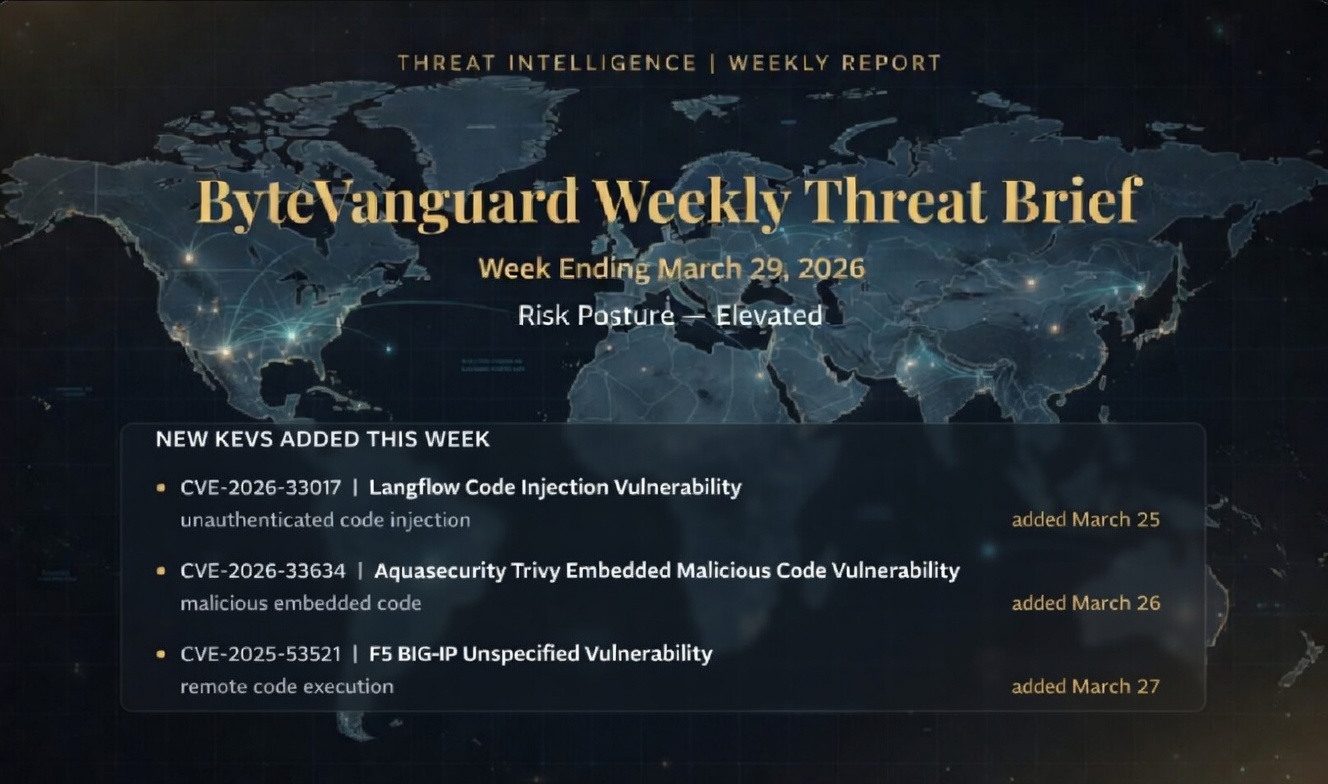
Overall Risk Posture: Elevated
The final full week of March 2026 reinforced a familiar but dangerous pattern: attackers continue to move quickly against exposed management infrastructure, trusted workflow platforms, and newly disclosed flaws with clear enterprise value. Evidence of suspected exploitation involving Quest KACE SMA, rapid abuse of a critical Langflow flaw, and fresh KEV pressure around F5 BIG-IP APM and Aqua Trivy all pointed to the same defensive lesson: when a vulnerability touches administrative control, workflow orchestration, or trusted security tooling, the remediation window is now extremely short.
For defenders, this was not a week defined by novelty. It was defined by speed, exposure, and the continuing operational cost of internet-facing control planes. Even where the latest browser fixes remained relevant, the more important pattern was the concentration of risk around systems that sit close to control, trust, or privileged workflows.
🔴 Active Exploitation and Immediate Risk
-
Quest KACE SMA Draws Fresh Exploitation Warnings
One of the clearest enterprise stories this week was Quest KACE Systems Management Appliance. SecurityWeek, citing Arctic Wolf, reported suspicious activity consistent with exploitation of CVE-2025-32975, a critical authentication-bypass flaw affecting unpatched, internet-exposed SMA instances. The reporting indicated that attackers were able to impersonate legitimate users and achieve administrative control over exposed appliances.
KACE sits in a high-trust position inside many environments for asset inventory, software deployment, patching, and monitoring. That matters because compromise of a management appliance is rarely contained to the appliance itself. When these systems remain exposed and outdated, they can quickly become enterprise-wide pivot points. -
Langflow Shows How Fast AI Tooling Is Entering the Exploitation Cycle
Langflow remained one of the week’s most important signals. Reporting from CISA-linked coverage and other security outlets showed that CVE-2026-33017, a critical flaw in the AI workflow platform, was exploited very quickly after disclosure, with KEV tracking now reinforcing its urgency. The defensive lesson is straightforward: AI workflow platforms that orchestrate actions, connect to APIs, or handle secrets should now be treated as high-value enterprise infrastructure, not experimental side tooling.
This is the bigger story behind Langflow. As more organizations operationalize LLM pipelines and automation layers, attackers no longer need to distinguish between “AI tooling” and “traditional infrastructure.” If a platform can trigger actions, access sensitive data, or sit in the middle of trusted workflows, it will be targeted like any other privileged system. -
New KEV Additions Keep Pressure on Security and Access Infrastructure
CISA’s Known Exploited Vulnerabilities catalog continued to add pressure this week, with key entries affecting security and access infrastructure. The most important items for many enterprise teams were CVE-2026-33634 affecting Aqua Trivy, CVE-2025-53521 affecting F5 BIG-IP APM, and CVE-2026-33017 affecting Langflow. Public reporting around the F5 issue emphasized that it is now being treated as an actively exploited remote code execution risk, with a March 30 remediation deadline for federal civilian agencies.
These are not routine product bugs in low-value software. They affect exactly the kinds of systems that amplify blast radius when compromised: access policy infrastructure, developer and security tooling, and workflow platforms that often sit close to credentials, network access, or internal automation.
🟠 Emerging Signals to Watch
-
Management Planes Remain the Soft Spot
This week’s stories all pointed back to a larger trend: exposed administrative layers remain one of the fastest routes to outsized impact. KACE is a management appliance. F5 often sits in front of sensitive applications and access workflows. Langflow may connect deeply into internal automation and AI pipelines. Trivy is trusted inside development and CI/CD environments. Different products, same lesson: attackers do not need a flashy new technique when they can compromise a trusted control point. -
Also Watching: Developer and macOS Social Engineering
Two additional stories from the last 48 hours are worth tracking. First, a campaign used fake Visual Studio Code security alerts posted in GitHub Discussions to trick developers into downloading malware. Second, researchers reported a new macOS ClickFix campaign delivering Infinity Stealer through fake verification lures. Neither story has the same control-plane significance as the KACE, F5, or Langflow issues, but both reinforce a practical reality: attackers continue to abuse trusted platforms and familiar workflows rather than relying only on software exploitation. -
Browser Hygiene Still Matters, but It Is Not the Main Story
Google released a Chrome stable desktop update on March 23 that included eight security fixes. Browser patching remains important because browsers still sit at the center of enterprise authentication, SaaS access, and session handling. However, this week’s dominant narrative was not browser exploitation. It was the concentration of serious risk in management and orchestration platforms with privileged operational roles.
🟢 Patch and Mitigation Priorities
Defenders should focus less on broad visibility and more on the systems that create outsized downstream impact if compromised.
- Immediately review exposure and patch status for Quest KACE SMA, especially any internet-facing instances.
- Treat Langflow as an urgent remediation item and review whether any exposed or weakly segmented deployments can reach sensitive APIs, credentials, or internal services.
- Address the newest KEV entries affecting F5 BIG-IP and Aqua Trivy on an emergency basis rather than pushing them into routine patch cycles.
- Review which administrative, security, and orchestration platforms remain reachable from the public internet.
- Verify Chrome rollout across managed endpoints, but do not let normal client patching distract from higher-consequence control-plane exposure.
Weekly Pulse
The week ending March 29 did not produce a single dominant zero-day story that overwhelmed everything else. Instead, it delivered something more familiar and more useful: multiple reminders that trusted infrastructure remains the shortest path to broad disruption.
Quest KACE, Langflow, F5 BIG-IP, and Aqua Trivy are very different technologies, but they share an important characteristic. Each sits close to control, trust, or privileged workflow. That is why flaws in these products matter so much once exploitation begins. The newest social-engineering stories aimed at developers and macOS users only reinforce the same broader point. Defenders are still losing ground wherever attackers can insert themselves into trusted operational paths.
Bottom Line
This week’s defensive message was straightforward: attackers are still winning by targeting exposed management surfaces, trusted workflow platforms, and recently added KEV items before organizations respond at operational speed.
The best-positioned teams will be the ones that treat these systems differently from ordinary software — with tighter exposure controls, faster emergency patching, and a clear assumption that compromise of a control plane can rapidly become compromise of the environment.
