
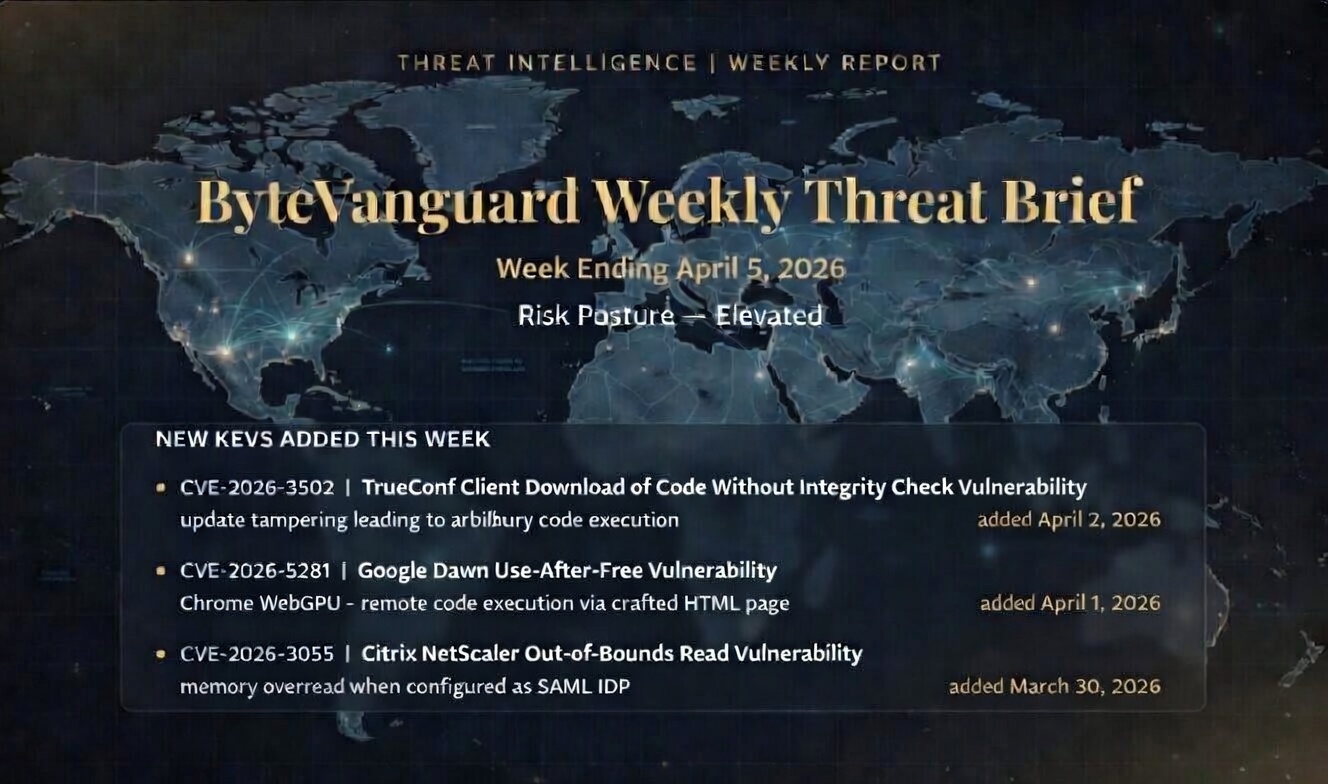
Overall Risk Posture: Elevated
The week ending April 5 reinforced a familiar 2026 pattern: attackers are moving quickly against systems tied to privilege, trust, and operational control. Fortinet disclosed an actively exploited FortiClient EMS flaw on April 4, Google pushed an emergency Chrome update on March 31 for CVE-2026-5281, and CISA elevated both Chrome’s Dawn bug and Citrix NetScaler CVE-2026-3055 into its Known Exploited Vulnerabilities focus during the week.
For defenders, the lesson did not change: platforms with administrative reach, identity adjacency, or broad downstream integrations remain the highest-consequence targets. Whether the entry point is an unauthenticated management flaw, an exposed identity edge, or a trusted update path, the blast radius is greatest where access, automation, and trust converge.
🔴 Active Exploitation and Immediate Risk
-
Fortinet FortiClient EMS under active exploitation
Fortinet warned on April 4 that CVE-2026-35616 in FortiClient EMS is being exploited in the wild. The company says the improper access control flaw may allow an unauthenticated attacker to execute unauthorized code or commands via crafted requests, and urges customers on affected 7.4.x builds to apply the hotfix immediately. For organizations using EMS as a central endpoint management layer, that makes this a high-priority control-plane issue.
FortiClient EMS sits in a sensitive operational position because it is trusted to help manage endpoints, enforce policy, and support remote administration. When a platform at that layer is exploitable without authentication, the concern is not just initial access but rapid privilege expansion and downstream control. This is exactly the type of trusted management surface that keeps showing up in 2026. -
Chrome zero-day keeps browser risk operationally relevant
Google released Chrome 146.0.7680.177/178 for Windows and Mac, and 146.0.7680.177 for Linux, to address CVE-2026-5281. Google said it was aware of exploitation in the wild, and CISA added the issue to KEV on April 1. Even when browser flaws do not dominate the week’s headlines, they remain identity-adjacent risk because browsers mediate SaaS access, authentication sessions, and administrative workflows all day long.
This also marks another reminder that client-side attack surfaces are still attractive to capable adversaries. Enterprise security teams often focus on servers and network edges first, but browsers remain one of the most exposed and continuously used trust layers in the environment. -
Citrix NetScaler keeps pressure on the identity edge
Citrix NetScaler CVE-2026-3055 deserves direct mention this week because it sits exactly where attackers like to operate: at the authentication and federation edge. Citrix describes the flaw as insufficient input validation leading to memory overread when NetScaler ADC and NetScaler Gateway are configured as a SAML IdP. CISA added it to KEV, while public reporting and defensive alerts indicated exploitation activity beginning in late March.
The practical takeaway is not that every NetScaler deployment is equally exposed, but that systems brokering federated identity deserve urgent review. If an appliance plays an identity-provider role, even a narrowly scoped flaw can carry outsized operational risk because it sits so close to authentication, session establishment, and trusted access flows.
🟠 Signals to Watch
-
Trusted update and delivery paths remain fragile
TrueConf CVE-2026-3502 showed how a product’s update flow could be turned into a malware delivery mechanism, with Check Point describing in-the-wild exploitation against Southeast Asian government targets and CISA adding the issue to KEV. That is a clear example of how trusted workflows can become the attack path when integrity controls fail. -
Social engineering still delivers outsized impact
The reported $285 million Drift theft added a different but important signal this week. According to reporting, the incident was tied to a DPRK-linked social engineering operation that built trust over months. That matters because it reinforces a separate reality alongside the vulnerability story: high-value compromise increasingly comes from patient abuse of human trust, not only from technical flaws.
🟢 Patch and Mitigation Priorities
- Apply Fortinet’s hotfixes for FortiClient EMS immediately where affected, and review any exposure of management interfaces. Systems with endpoint-wide visibility or policy reach should be treated as high-consequence assets, not routine infrastructure.
- Update Chrome across the fleet to the latest stable release to address CVE-2026-5281, and verify coverage on systems where browser updates lag behind policy or user behavior.
- Review Citrix NetScaler deployments specifically for SAML IdP exposure and patch status. In identity-facing infrastructure, precision matters, but speed matters too. A flaw that only affects a certain role can still become a major risk if that role sits directly on the federation path.
- Audit trusted update and internal delivery mechanisms, especially where central servers distribute software or configuration downstream. The TrueConf case is a reminder that a trusted workflow can become the attack path when integrity controls fail.
- Strengthen high-friction verification for sensitive financial, administrative, and access-related actions. The Drift case shows that patient social engineering can bypass strong technical controls when people and process remain the weak link.
Weekly Pulse
The week ending April 5 did not revolve around one single catastrophic headline. Instead, it reinforced the operational reality now defining 2026: attackers move fastest where trust, privilege, and integration are concentrated. FortiClient EMS, Chrome’s Dawn flaw, and Citrix NetScaler each highlight a different part of the same problem: the most dangerous assets are often the ones defenders rely on to manage, authenticate, or connect everything else.
Bottom Line
Attackers continue to gain advantage by targeting exposed management surfaces, trusted tooling, identity-adjacent infrastructure, and human trust channels before organizations fully respond. The strongest posture this week is not broad awareness but fast, disciplined remediation: patch high-privilege systems first, reduce internet exposure, verify trusted update paths, and treat trust-heavy workflows as part of the attack surface.
