
Overall Risk Posture: Elevated
The week ending April 19 was defined by layered remediation pressure rather than one single headline exploit. On April 13, CISA added seven new vulnerabilities to the Known Exploited Vulnerabilities catalog. On April 14, Microsoft’s Patch Tuesday cycle landed with fresh security updates, including an actively exploited SharePoint issue. CISA then added two more KEVs on April 14 and another on April 16, when Apache ActiveMQ joined the catalog.
Looked at as a whole, the week was heavier than a routine update cycle. The latest exploit queue was not limited to the April 13 cluster. It also still included earlier high-consequence entries such as Ivanti EPMM and FortiClient EMS, both of which remained relevant to defenders working through active-exploitation-driven patching. At the same time, Microsoft documented that some Windows domain controllers could restart repeatedly after patching in certain Privileged Access Management environments, turning patch validation itself into part of the week’s risk story.
Active Exploitation and Immediate Risk
-
April 13 was a real KEV surge, not a background update
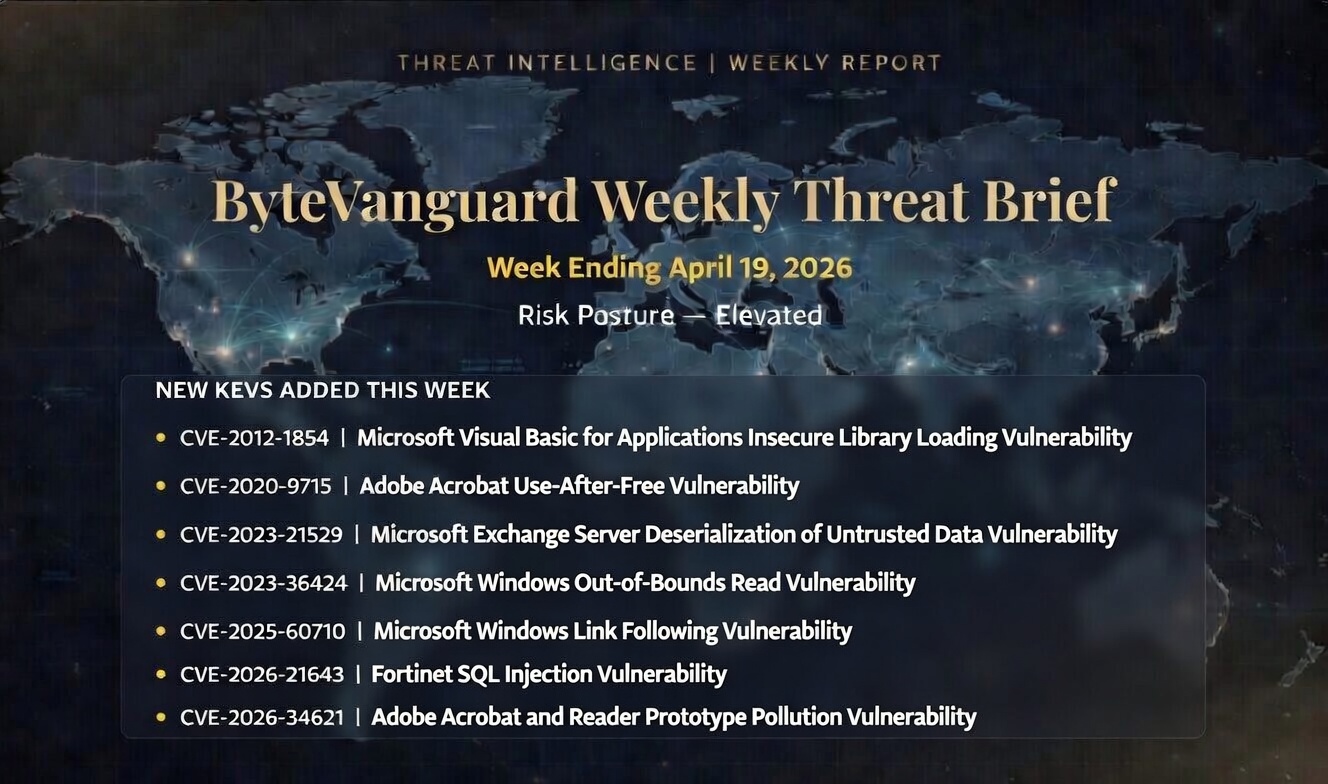
CISA added seven vulnerabilities on April 13, and the list was unusually broad in both age and attack surface. The additions included CVE-2012-1854, CVE-2020-9715, CVE-2023-21529, CVE-2023-36424, CVE-2025-60710, CVE-2026-21643, and CVE-2026-34621. That mix mattered because it showed attackers still finding value in legacy Office-related components, document software, Exchange infrastructure, Windows internals, and management software. -
Patch Tuesday included an actively exploited SharePoint issue
Microsoft’s April 2026 security updates included CVE-2026-32201, a SharePoint spoofing vulnerability associated with in-the-wild exploitation. That mattered because SharePoint sits inside document handling, internal collaboration, and trusted business workflows. When exploitation reaches that layer, the concern is not only server compromise but also how easily malicious activity can blend into normal enterprise behavior. -
The KEV queue kept growing after Patch Tuesday
CISA followed the April 13 surge with two more additions on April 14, including CVE-2009-0238 and CVE-2026-32201. On April 16, CISA added CVE-2026-34197, an Apache ActiveMQ improper input validation vulnerability. That cadence reinforced the broader point of the week: the exploit-backed priority queue was still expanding while defenders were already managing Patch Tuesday activity. -
The latest exploit view also still reflected earlier management-plane risk
The “latest 10 exploits” view did not only show the April 13–16 additions. It also still reflected earlier active-exploitation entries such as CVE-2026-1340 in Ivanti Endpoint Manager Mobile and CVE-2026-35616 in FortiClient EMS. That matters editorially because it means the week’s risk was not isolated to one vendor family. Administrative and management-layer platforms were still very much part of the exploit picture. -
Domain controller instability made patching itself part of the week’s risk story
Microsoft later documented that some domain controllers could restart repeatedly after the April 14 security updates due to LSASS crashes during startup in environments with multiple domains in the forest that use Privileged Access Management. The issue was not limited to one server generation. Microsoft published affected-status or resolution guidance across Windows Server 2016, 2019, 2022, version 23H2, and 2025. That changed the real-world question from “How fast can we deploy?” to “How fast can we deploy safely on systems that anchor authentication and directory services?”
Signals to Watch
-
KEV volume matters because it changes remediation order immediately
A seven-item KEV expansion at the start of the week is not just a statistical note. Add the follow-on April 14 and April 16 entries, and the pattern becomes clearer: defenders had to keep re-sequencing work in real time as active exploitation was confirmed. -
Trusted collaboration, messaging, and middleware platforms remained high-consequence targets
SharePoint, Exchange, ActiveMQ, and document software are different technologies, but they share an important trait: they sit close to workflows users and systems already trust. Exploitation there can create more downstream impact than a simple product label suggests. -
Old vulnerabilities are still current operational problems
The latest entries stretched from CVE-2009-0238 and CVE-2012-1854 through 2026-era flaws. That time span is the point. Attackers do not organize around novelty. They organize around opportunity. -
Identity infrastructure needs a different patching posture
Domain controllers, PAM-linked environments, and authentication-dependent services should not be treated like routine server fleets. This week reinforced that some systems require staged rollout, validation, and rollback planning because the operational cost of failure is too high. -
Management-plane weaknesses still deserve outsized attention
The continued presence of Ivanti EPMM and FortiClient EMS in the latest exploit picture is a reminder that administrative platforms carry high downstream risk. When those systems are exposed, compromise can affect policy, device management, and broader control layers.
Patch and Mitigation Priorities
- Prioritize the actively exploited Microsoft items from the April cycle first, especially where SharePoint, Exchange, or other high-trust enterprise services are present.
- Review the April 13 KEV additions as a queue-changing event. In practice, that means checking exposure to CVE-2023-21529, CVE-2026-21643, CVE-2026-34621, and the other KEV-listed systems immediately.
- Do not ignore the newer additions from April 14 and April 16. CVE-2026-34197 adds middleware exposure to the week’s patch stack, while CVE-2009-0238 shows how old Office-related debt can still return as a live exploit priority.
- Accelerate updates for user-facing document software and systems that regularly process untrusted files. Adobe’s presence in the April 13 KEV cluster is a reminder that familiar document workflows still matter.
- Treat management platforms such as Ivanti EPMM and FortiClient EMS as high-consequence remediation candidates rather than ordinary backlog items.
- Validate domain controllers and PAM-related environments carefully before broad deployment of the April Windows Server updates. Identity infrastructure deserves staged rollout and contingency planning.
- Where affected domain controllers are running the April 2026 Windows Server security updates, use Microsoft’s mitigation or out-of-band resolution path for the relevant server version rather than treating the problem as routine post-patch instability.
Weekly Pulse
The week ending April 19 was operationally heavy because defenders were hit from multiple directions at once. April 13 brought a seven-item KEV surge. April 14 delivered Patch Tuesday, including an actively exploited SharePoint issue, and CISA added two more KEVs. April 16 added Apache ActiveMQ to the list. Meanwhile, earlier management-plane exposures like Ivanti EPMM and FortiClient EMS remained part of the latest exploit queue, and Microsoft acknowledged a domain controller restart problem tied to the same update window across multiple Windows Server releases. The lesson was not only to move fast. It was to move fast with the right sequencing, and with extra care around infrastructure that anchors identity and access.
Bottom Line
This week’s threat picture was not defined by one exploit. It was defined by compression: a KEV surge, Patch Tuesday, more KEV additions after Patch Tuesday, lingering management-plane exposure, and patch fallout in domain controller environments. That combination is what made the week elevated. Patch the actively exploited issues first, treat KEV additions as real reprioritization events, and validate identity infrastructure carefully when security updates intersect with authentication stability.
Sources
- CISA — CISA Adds Seven Known Exploited Vulnerabilities to Catalog (April 13, 2026)
- CISA — CISA Adds Two Known Exploited Vulnerabilities to Catalog (April 14, 2026)
- CISA — CISA Adds One Known Exploited Vulnerability to Catalog (April 16, 2026)
- CISA — Known Exploited Vulnerabilities Catalog
- Microsoft Security Update Guide — April 2026 Release Notes
