
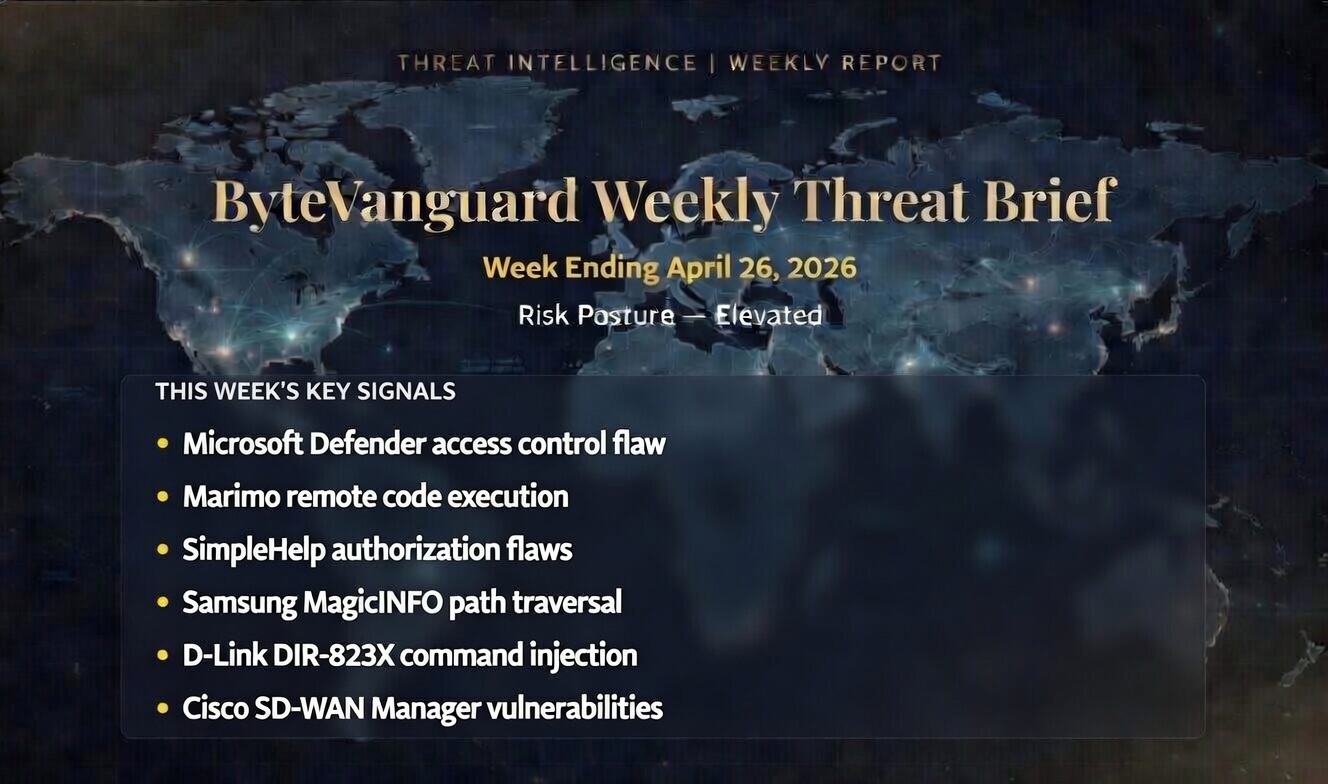
Overall Risk Posture: Elevated
The week ending April 26 was defined by exploited tools, exposed management layers, and persistent edge-device risk. CISA’s Known Exploited Vulnerabilities catalog reflected active exploitation across Cisco Catalyst SD-WAN Manager, Microsoft Defender, Marimo, SimpleHelp, Samsung MagicINFO, D-Link routers, PaperCut, JetBrains TeamCity, Quest KACE, Zimbra, and Kentico Xperience.
The week was not only about applying patches. CISA’s FIRESTARTER malware analysis highlighted the risk that compromised Cisco ASA and Firepower devices may require more than standard remediation. Sysdig also reported exploitation activity involving Marimo, reinforcing why developer and data platforms should be treated as part of the enterprise attack surface.
The larger pattern was clear: attackers are still looking for leverage. They are targeting systems that manage networks, protect endpoints, support users, run developer workflows, or sit at the internet edge. For defenders, the question is not only “Is there a CVE?” The better question is: “What does this system control if it is compromised?”
Active Exploitation and Immediate Risk
-
April 20 brought a broad KEV surge across enterprise tooling
CISA added eight vulnerabilities to the KEV catalog on April 20. The list covered print management, CI/CD infrastructure, endpoint management, collaboration platforms, content systems, and SD-WAN management. The affected vulnerabilities included CVE-2023-27351, CVE-2024-27199, CVE-2025-2749, CVE-2025-32975, CVE-2025-48700, CVE-2026-20122, CVE-2026-20128, and CVE-2026-20133. That mix matters because several of these systems sit close to administration, software delivery, device management, or trusted business workflows. -
Cisco SD-WAN Manager kept management-layer risk in focus
The Cisco Catalyst SD-WAN Manager vulnerabilities were among the most important entries because SD-WAN management infrastructure helps shape how traffic moves across an enterprise. If that layer is exposed or compromised, attackers may gain insight into routing, segmentation, credentials, and administrative workflows. This is why management-layer vulnerabilities often deserve faster handling than ordinary application flaws. -
Microsoft Defender entered the KEV queue
On April 22, CISA added CVE-2026-33825, a Microsoft Defender insufficient access control vulnerability. This is an uncomfortable category because Defender is part of the security stack itself. A flaw in endpoint protection affects a tool many organizations depend on for prevention, detection, investigation, and response. The issue should be treated as a security-tooling priority, not just another endpoint update. -
Marimo showed why developer tools can become production risk
On April 23, CISA added CVE-2026-39987, a Marimo remote code execution vulnerability. Sysdig reported exploitation activity involving Marimo, including attacker use of the flaw in a campaign tied to botnet deployment. The broader defensive lesson is that notebook and developer platforms can become sensitive infrastructure when they can execute code, hold credentials, or connect to internal systems. -
Remote support, digital signage, and routers closed the week’s KEV list
On April 24, CISA added four more exploited vulnerabilities: CVE-2024-7399 in Samsung MagicINFO, CVE-2024-57726 and CVE-2024-57728 in SimpleHelp, and CVE-2025-29635 in D-Link DIR-823X routers. The SimpleHelp entries are especially important because remote support tools are trusted by design. They are built to reach endpoints, assist users, and support administrative action. If that trust is abused, attackers may not need to look like outsiders for long. -
Cisco FIRESTARTER showed that patching does not always mean clean
CISA’s FIRESTARTER malware analysis highlighted persistence risk on Cisco ASA and Firepower devices. The key lesson was not only that edge appliances were targeted. The bigger issue was persistence. If malware survives patching or allows attackers to return without re-exploiting the original vulnerability, defenders cannot treat firmware updates as the end of the incident. Edge-device remediation needs compromise assessment, configuration review, credential review, and validation that persistence has actually been removed.
Signals to Watch
-
KEV volume is still reshaping the patch queue
This was another week where active exploitation, not theoretical severity, had to drive remediation order. CISA’s additions were spread across several product categories, which means defenders could not solve the week with one vendor advisory or one emergency maintenance window. The right approach is to map each KEV entry against asset inventory, internet exposure, privilege level, and business function. -
Management-layer software remains a high-value target
Cisco SD-WAN Manager, Quest KACE, PaperCut, TeamCity, SimpleHelp, and Defender are different technologies, but they share one important trait: they sit close to control. Some manage networks. Some manage endpoints. Some support users. Some build software. Some protect systems. That is exactly why attackers care about them. -
Security tools need security monitoring too
The Microsoft Defender KEV entry is a useful reminder that security products are still software. They can have vulnerabilities, they can be abused after initial access, and they can become part of the attack path. Teams should monitor for unusual Defender behavior, privilege escalation, tampering attempts, and endpoint protection gaps after patching. -
Remote support tools deserve more scrutiny
Remote support platforms often carry broad access and strong user trust. That makes them useful to IT teams, but also useful to attackers. If a remote support tool is internet-facing or loosely controlled, it should be reviewed for MFA, access restrictions, session logging, administrative permissions, and patch status. -
Developer and data platforms are part of the attack surface
The Marimo RCE entry reinforces a broader point: notebook servers, internal dashboards, automation apps, and data science platforms can become sensitive infrastructure. If they can execute code, store secrets, or connect to internal systems, they should not be treated like harmless side projects. -
Edge-device persistence requires more than routine patching
CISA’s FIRESTARTER analysis reinforces a practical response lesson: when an edge device is compromised, patching the vulnerability may not be enough. Defenders also need to assess persistence, configuration changes, credentials, access paths, and evidence that the device was actually cleaned.
Patch and Mitigation Priorities
- Prioritize KEV-listed systems that manage access, endpoints, traffic, code, remote sessions, or security controls. This includes Cisco Catalyst SD-WAN Manager, Quest KACE, PaperCut, JetBrains TeamCity, SimpleHelp, and Microsoft Defender.
- Validate Microsoft Defender updates for CVE-2026-33825, and review endpoint telemetry for suspicious privilege escalation, tampering, or unexpected Defender behavior.
- Review Cisco ASA, Firepower, VPN, and firewall environments for signs of compromise where relevant. Do not assume that patching alone removed persistence if the device was already compromised.
- Check exposure to Marimo and similar developer/data platforms. Any internet-facing notebook or code-execution environment should have strong authentication, restricted network access, patch ownership, and logging.
- Review SimpleHelp deployments immediately where present. Remote support tools should have MFA, limited administrative scope, session monitoring, and restricted access from trusted networks where possible.
- For D-Link DIR-823X exposure, treat replacement or discontinuation as a serious mitigation path where patching is not realistic or vendor support is limited.
- Use the week’s KEV additions as a prioritization signal, not just a reference list. The most urgent systems are the ones that are exploitable, exposed, privileged, or tied to administration and trust.
Weekly Pulse
The week ending April 26 was operationally heavy because the threat picture came from several directions at once. April 20 brought eight KEV additions across enterprise tooling and SD-WAN management. April 22 added Microsoft Defender to the active-exploitation queue. April 23 brought Marimo RCE into the KEV catalog. April 24 added Samsung MagicINFO, SimpleHelp, and D-Link router vulnerabilities. Outside the KEV queue, CISA’s FIRESTARTER malware analysis showed why compromised edge devices may require deeper validation than patching alone.
The common thread was leverage. Attackers targeted systems that help manage networks, secure endpoints, support users, execute code, route traffic, or maintain access. That is why the week stayed elevated even without one single headline vulnerability dominating the cycle.
Bottom Line
This week’s threat picture was not defined by one exploit. It was defined by exploited tools, exposed management layers, and persistent edge-device risk. CISA’s KEV additions showed attackers moving across enterprise software, remote support, endpoint security, developer platforms, routers, and SD-WAN management. CISA’s FIRESTARTER analysis showed that patching can close a vulnerability while leaving compromise concerns behind.
For defenders, the priority is to rank risk by attacker utility. Patch the KEV systems that matter most, validate security tooling, assess exposed management layers, review remote support access, and treat compromised edge devices as potential persistence points, not just patching tasks.
Sources
- CISA — Known Exploited Vulnerabilities Catalog
- Microsoft Security Response Center — CVE-2026-33825: Microsoft Defender Vulnerability
- CISA Advisory AA26-113A — Threat Actor Exploitation of Cisco ASA and Cisco Firepower Threat Defense Software
- CISA Malware Analysis Report AR26-113A — FIRESTARTER Backdoor
- Sysdig — CVE-2026-39987: How Attackers Weaponized Marimo
