
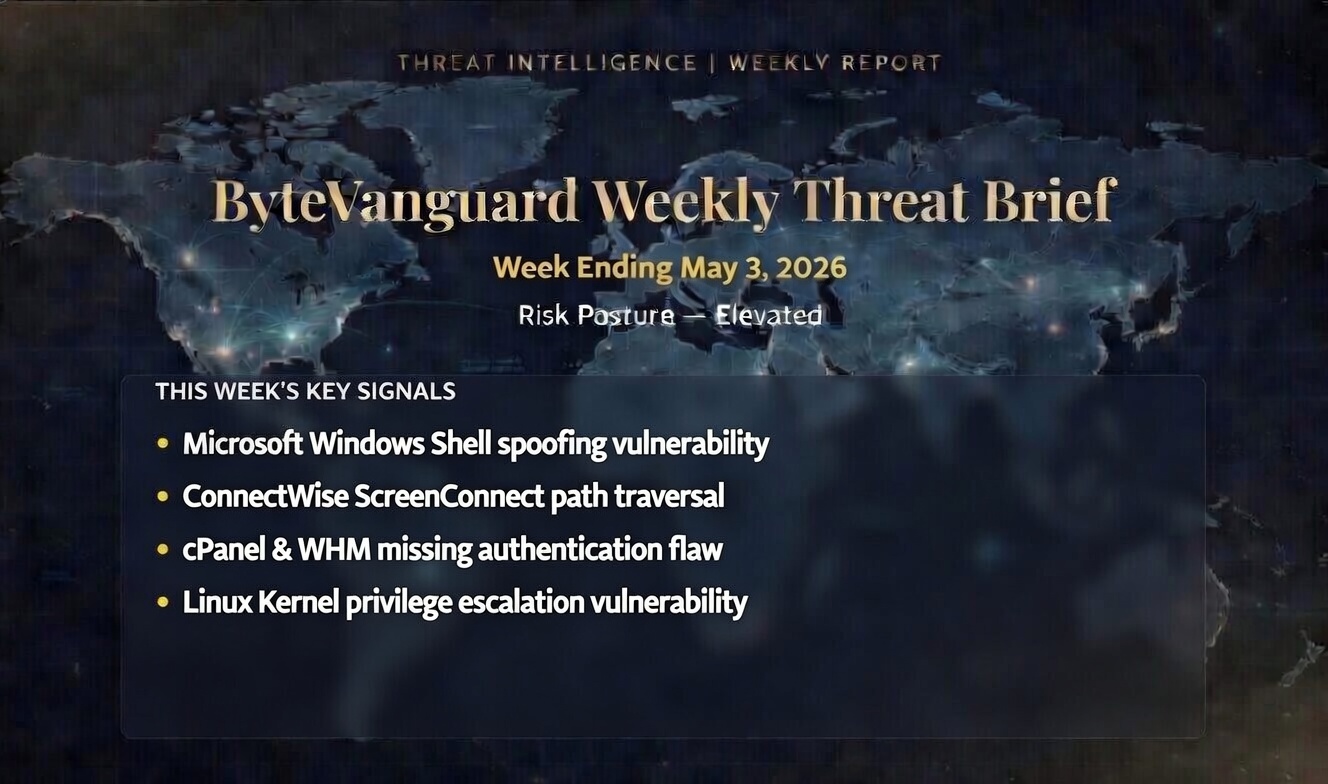
Overall Risk Posture: Elevated
The week ending May 3 was defined by control-plane pressure, remote access exposure, hosting administration risk, and Linux privilege escalation. CISA’s Known Exploited Vulnerabilities catalog reflected active exploitation across ConnectWise ScreenConnect, Microsoft Windows Shell, WebPros cPanel & WHM, WP2, and the Linux kernel.
The pattern was not limited to one vendor or one product category. The week showed attackers continuing to target systems that sit close to administration, hosting, endpoint workflows, and cloud workloads. These are not ordinary application flaws. They affect software that often controls other systems, supports privileged access, or runs in environments where one compromise can quickly become broader exposure.
The clearest message for defenders is simple: exploited vulnerabilities in management and infrastructure layers should not be handled as routine patching. They deserve asset validation, exposure review, privilege review, and post-patch compromise assessment.
Active Exploitation and Immediate Risk
-
ConnectWise ScreenConnect returned to the KEV queue
On April 28, CISA added CVE-2024-1708, a ConnectWise ScreenConnect path traversal vulnerability, to the KEV catalog. ScreenConnect matters because remote support platforms are trusted by design. They are built to reach endpoints, support users, and allow administrators to troubleshoot systems across an environment.
That trust is exactly what makes remote support tools attractive to attackers. If a remote support server is exposed, outdated, or loosely controlled, it can become a shortcut into systems that would otherwise require separate access paths. Even when the original vulnerability is older, a KEV addition means defenders should treat remaining exposure as current operational risk, not historical noise.
For self-hosted ScreenConnect environments, the priority is to confirm the server version, validate patch status, review administrator accounts, and inspect access logs for suspicious activity. Remote support infrastructure should also be reviewed for MFA, IP restrictions, session recording, and least-privilege configuration. -
Microsoft Windows Shell added spoofing risk to the week
CISA also added CVE-2026-32202, a Microsoft Windows Shell protection mechanism failure vulnerability. While the severity score is lower than some of the infrastructure flaws added this week, the product footprint matters.
Windows Shell vulnerabilities can become useful in broader intrusion chains. Spoofing and protection bypass issues may not always be the first exploit in an attack, but they can help attackers deceive users, support follow-on execution, or weaken trust in the desktop environment. In enterprise environments, these flaws should be handled through normal Windows patch validation, especially on high-risk user workstations, administrative jump boxes, and systems used to access sensitive applications. -
cPanel and WHM became the highest urgency hosting risk
On April 30, CISA added CVE-2026-41940, a WebPros cPanel & WHM and WP2 authentication bypass vulnerability. This was one of the most important entries of the week because cPanel sits directly in the hosting control layer.
An authentication bypass in a hosting control panel is not just a website issue. It can expose account management, mail, DNS, files, databases, domains, and administrative workflows. For hosting providers, agencies, small businesses, and anyone managing multiple customer sites, the control panel can become a central point of failure.
WebPros published patched versions and required actions for affected cPanel & WHM, DNSOnly, and WP2 versions. Because the KEV due date was May 3, this should be treated as an immediate verification item, especially for internet-facing WHM and cPanel interfaces. -
Linux “Copy Fail” shifted attention to cloud and container workloads
On May 1, CISA added CVE-2026-31431, a Linux kernel incorrect resource transfer vulnerability also referred to as “Copy Fail.” The vulnerability is a local privilege escalation issue, which means an attacker generally needs local code execution first. That does not make it low priority.
In modern environments, local code execution is often not the end of an attack path. It can happen through a compromised application, vulnerable container, CI/CD job, malicious package, exposed notebook, web shell, or stolen developer credential. Once an attacker has limited execution, a reliable Linux privilege escalation can turn a contained foothold into root-level access.
This is especially important for cloud workloads, Kubernetes clusters, shared Linux systems, build servers, and CI/CD runners. These environments often run untrusted or semi-trusted code and depend heavily on isolation boundaries. A kernel-level privilege escalation issue can weaken those boundaries and increase the risk of lateral movement, container escape, or deeper infrastructure compromise.
Signals to Watch
-
Control panels are becoming frontline infrastructure
The cPanel entry is a reminder that control panels should be treated as sensitive infrastructure. A hosting dashboard may look like an administrative convenience, but it often controls domains, files, databases, mailboxes, backups, and credentials. If exposed to the internet, it deserves the same level of access control and monitoring as VPN, firewall, identity, and endpoint management systems. -
Remote support tools remain high-value targets
ScreenConnect belongs in the same risk conversation as RMM tools, helpdesk tooling, endpoint management systems, and remote administration platforms. These tools are useful because they are trusted. That also means compromise can give attackers a path that blends into normal IT behavior. Defenders should monitor remote sessions, new technician accounts, unusual administrative actions, and connections from unexpected geographies or networks. -
Linux privilege escalation is cloud risk, not only server risk
Copy Fail should not be viewed only as a traditional Linux server issue. The higher-risk environments are the ones where limited code execution is common: container platforms, shared runners, build systems, developer workspaces, and multi-tenant workloads. In those environments, local privilege escalation can become the bridge between initial access and full system control. -
Patch deadlines are getting operationally tighter
The cPanel KEV entry carried a very short remediation window. That reflects a broader reality: when exploitation is active and the affected technology controls sensitive infrastructure, defenders may not have weeks to respond. Teams need a faster process for identifying exposed assets, mapping ownership, applying emergency updates, and validating that the system is clean after patching. -
Older vulnerabilities can become current risk again
The ScreenConnect entry shows why older vulnerabilities should not disappear from the risk register if exposed systems remain unpatched. Attackers do not care whether a flaw is new. They care whether it still works. KEV additions are useful because they help defenders separate theoretical vulnerability management from exploitation-driven prioritization.
Patch and Mitigation Priorities
- Confirm whether any internet-facing cPanel, WHM, DNSOnly, or WP2 systems are affected by CVE-2026-41940. Apply the WebPros updates, restart the relevant services, and review session and access logs for suspicious activity.
- Review exposed ScreenConnect servers for CVE-2024-1708. Confirm patched versions, review administrator accounts, inspect access logs, and restrict management access where possible.
- Patch Linux systems affected by CVE-2026-31431, with priority on cloud hosts, Kubernetes nodes, CI/CD runners, build servers, shared Linux environments, and systems that run untrusted workloads.
- Validate Microsoft Windows updates for CVE-2026-32202, especially for administrative workstations and systems used to access sensitive applications.
- Use KEV status as a prioritization signal. Focus first on exploited systems that are internet-facing, privileged, tied to administration, or able to affect multiple downstream assets.
- After patching management-layer software, perform compromise assessment. For control panels and remote support systems, patching should be followed by account review, token review, session review, log review, and credential rotation where exposure is suspected.
Weekly Pulse
The week ending May 3 did not produce one single dominant vendor story. Instead, it showed a consistent attacker preference for leverage. ConnectWise ScreenConnect represented remote access and support infrastructure. Microsoft Windows Shell represented user-facing operating system trust. WebPros cPanel and WHM represented hosting control planes. Linux Copy Fail represented the risk of local privilege escalation across servers, cloud workloads, containers, and shared compute environments.
Those categories are different, but the operational lesson is the same. Attackers are looking for places where one successful exploit gives them more than one machine. They want systems that manage other systems, control access, host many assets, or help them move from limited execution to deeper privilege.
That is why the week remains elevated. The risk is not only the CVE list. The risk is what those systems control after compromise.
Bottom Line
This week’s threat picture was defined by control-plane pressure. CISA’s KEV additions showed active exploitation affecting remote support software, Windows components, hosting management platforms, and the Linux kernel. The most urgent issue was not only patch availability. It was exposure, privilege, and attacker utility.
For defenders, the priority is to identify systems that sit close to administration and shared infrastructure. Patch cPanel and WHM immediately where present. Validate ScreenConnect exposure. Prioritize Linux kernel updates for cloud, container, and CI/CD environments. Apply Windows updates where applicable. Then verify whether exploitation occurred before the patch was applied.
The week’s lesson is straightforward: when attackers target the systems that manage everything else, remediation cannot stop at “update installed.” It has to include validation that control has not already been lost.
Sources
- CISA — Known Exploited Vulnerabilities Catalog
- WebPros cPanel — CVE-2026-41940 cPanel & WHM / WP2 Security Update
- NVD — CVE-2026-41940
- ConnectWise — ScreenConnect 23.9.8 Security Fix
- NVD — CVE-2024-1708
- Microsoft Security Response Center — CVE-2026-32202
- NVD — CVE-2026-31431
- Microsoft Security Blog — CVE-2026-31431 Copy Fail Linux Root Privilege Escalation
- Tenable — Copy Fail CVE-2026-31431 FAQ
