
AI vulnerability research is moving from experimental tooling into structured security engineering.
Microsoft’s May 2026 disclosure around MDASH — its multi-model agentic security system — is a useful signal of where vulnerability discovery is heading. The story is not simply that Microsoft used AI. The more important point is that AI agents are starting to participate directly in the vulnerability research workflow: code review, exploitability reasoning, validation, and prioritization.
That matters because vulnerability discovery has always been a race. Vendors want to find bugs before attackers do. Researchers want to prove impact responsibly. Defenders want enough time to patch before exploitation begins. If AI-assisted systems can accelerate discovery, that race becomes faster on every side.
| Topic | AI-assisted vulnerability discovery |
|---|---|
| Primary Example | Microsoft MDASH, a multi-model agentic security system used in vulnerability research |
| Reported Outcome | Microsoft reported 16 newly identified vulnerabilities across Windows networking and authentication components |
| Most Important Theme | Vulnerability research is becoming more automated, agentic, and pipeline-driven |
| Defender Relevance | Patch prioritization, exposure management, secure development, vendor risk, and exploitability assessment |
| Risk Posture | Emerging — not a single exploit event, but a meaningful shift in the vulnerability lifecycle |
| Primary Security Question | Who uses AI-assisted vulnerability discovery first: the vendor, the researcher, or the attacker? |
On May 12, 2026, Microsoft published research describing MDASH, short for Microsoft Security’s multi-model agentic scanning harness. Microsoft said the system helped researchers identify 16 new vulnerabilities across the Windows networking and authentication stack, including four Critical remote code execution vulnerabilities.
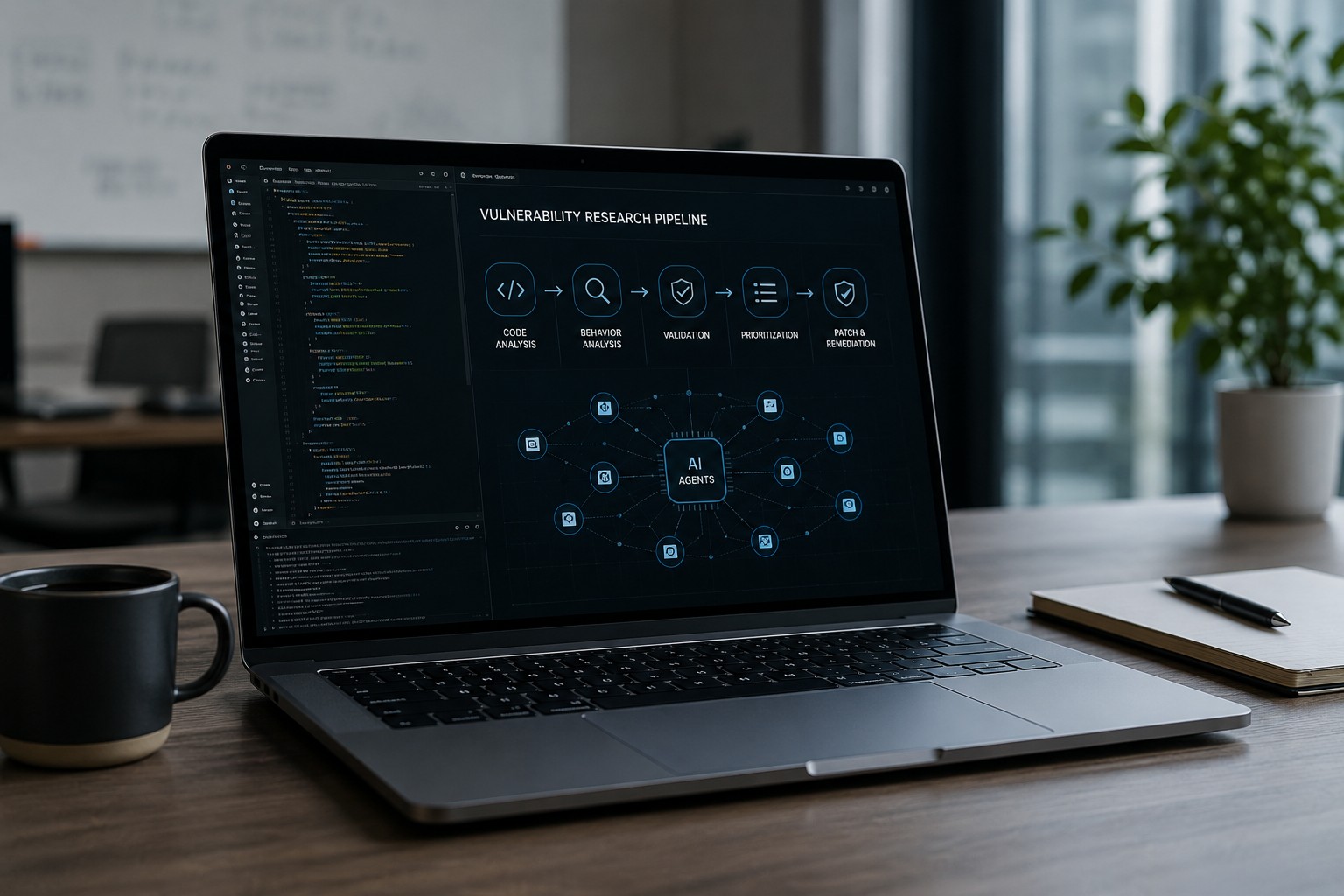
Microsoft described MDASH as a system using more than 100 specialized AI agents across multiple models. These agents are designed to inspect code, reason about possible vulnerability paths, debate findings, and help determine whether a suspected issue may be exploitable.
The technical details matter to security researchers, but the broader signal matters to defenders: AI is being inserted into the vulnerability discovery process itself, not just into alert triage or security reporting.
This is not the same issue as AI agents accelerating exploitation after a vulnerability becomes public.
That problem is about speed after disclosure: how quickly attackers can move from a known flaw to working exploitation, especially when the vulnerability affects exposed systems or appears in CISA’s Known Exploited Vulnerabilities catalog.
MDASH points to a different part of the lifecycle. It is about discovery before exploitation is observed, before a vulnerability is widely known, and before defenders are forced into emergency response mode.
The distinction is important. One issue asks whether defenders can patch fast enough after a bug becomes known. The other asks whether vendors, researchers, and attackers can use AI to find those bugs earlier in the first place.
Most enterprise security teams are used to thinking about AI as an assistant. A model can summarize an alert, explain a suspicious command, draft a detection query, or help an analyst understand a vulnerability advisory.
Those use cases are useful, but they place AI beside the analyst.
AI-assisted vulnerability research places AI inside the discovery process. Instead of only explaining what has already happened, the system helps identify what may be wrong.
That workflow can include reviewing code for suspicious patterns, identifying possible memory safety or logic flaws, reasoning about exploitability, comparing suspected issues against known vulnerability classes, filtering weak findings, and helping researchers decide which bugs deserve deeper review.
This does not eliminate human researchers. It changes how much early-stage analysis can be automated before a human makes the final call.
At first, Microsoft’s MDASH announcement may look like a vendor-side engineering story. Microsoft found Windows bugs using Microsoft security research tooling. For most enterprise defenders, that might sound distant from daily operations.
It is not.
If AI-assisted vulnerability discovery becomes more effective, defenders may see larger advisory volumes, faster patch cycles, and more pressure to separate urgent vulnerabilities from lower-priority noise.
The biggest impact may be prioritization. CVSS alone already fails to answer the most important operational question: which vulnerabilities can create real damage in this environment? A critical vulnerability on an isolated system may be less urgent than a lower-scored issue on an exposed authentication service, VPN, firewall, or endpoint management platform.
AI may eventually help vendors and defenders reason more clearly about exploitability. But attackers can also use similar workflows to explore open-source projects, leaked code, firmware, appliances, and exposed services.
Faster vulnerability discovery does not automatically make organizations safer. It only helps if defenders can connect new advisories to real assets quickly.
Security teams should prioritize systems where exploitation would create the most damage: internet-facing services, identity infrastructure, VPNs, firewalls, remote access platforms, endpoint management systems, cloud control planes, and software with privileged access to other systems.
This is where vulnerability intelligence becomes operational. A new advisory matters more when the affected product is exposed, business-critical, tied to identity, or already showing exploit signals.
That means defenders need more than a monthly patch spreadsheet. They need asset ownership, exposure context, exploit intelligence, and detection coverage around the systems most likely to become targets.
This is not a reason to panic. It is a reason to strengthen the controls that matter when vulnerability timelines compress.
Maintain a clear inventory of internet-facing systems, critical applications, identity services, remote access platforms, and business-critical infrastructure. A vulnerability on an ownerless system is harder to prioritize, harder to patch, and harder to defend.
Do not rely only on severity labels. Combine vendor severity with CISA KEV status, EPSS or other exploit-likelihood signals, public proof-of-concept activity, internet exposure, business criticality, and whether the affected system has privileged access.
Improve telemetry around authentication services, exposed network services, edge appliances, remote access tools, endpoint management platforms, and cloud administrative systems. If exploitation starts before patching is complete, these are the places where visibility matters most.
Security and procurement teams should ask how vendors find and validate vulnerabilities before release. Useful questions include whether the vendor uses fuzzing, static analysis, dynamic analysis, AI-assisted review, exploitability validation, and transparent patch communication.
The useful way to understand Microsoft’s MDASH announcement is not as an isolated AI research milestone. It is a signal that vulnerability research is becoming more industrialized.
More agents. More automation. More exploitability reasoning. More validation. More findings moving through a structured pipeline before they reach defenders as advisories and patches.
For vendors, that may improve secure engineering. For researchers, it may expand what can be reviewed. For attackers, it may lower the cost of exploring weaknesses in complex systems.
For defenders, the response model has to mature. Monthly patch review alone is not enough. Organizations need to combine vulnerability intelligence with asset context, exposure data, identity risk, and detection coverage.
AI vulnerability research is becoming an engineering pipeline.
Microsoft’s MDASH is worth watching because it shows how agentic systems can help discover real vulnerabilities inside complex software. That does not remove the need for human researchers, and it does not magically solve vulnerability management.
But it does change the speed and structure of the vulnerability lifecycle.
The future of vulnerability management will not be defined only by who patches. It will also be defined by who discovers first, who validates fastest, and who understands exposure before exploitation begins.
ByteVanguard tracks AI security, KEV activity, and enterprise threat intelligence. Subscribe for weekly briefings.
If you find ByteVanguard useful, you can support the site and help keep the analysis independent.
Support the analysis