

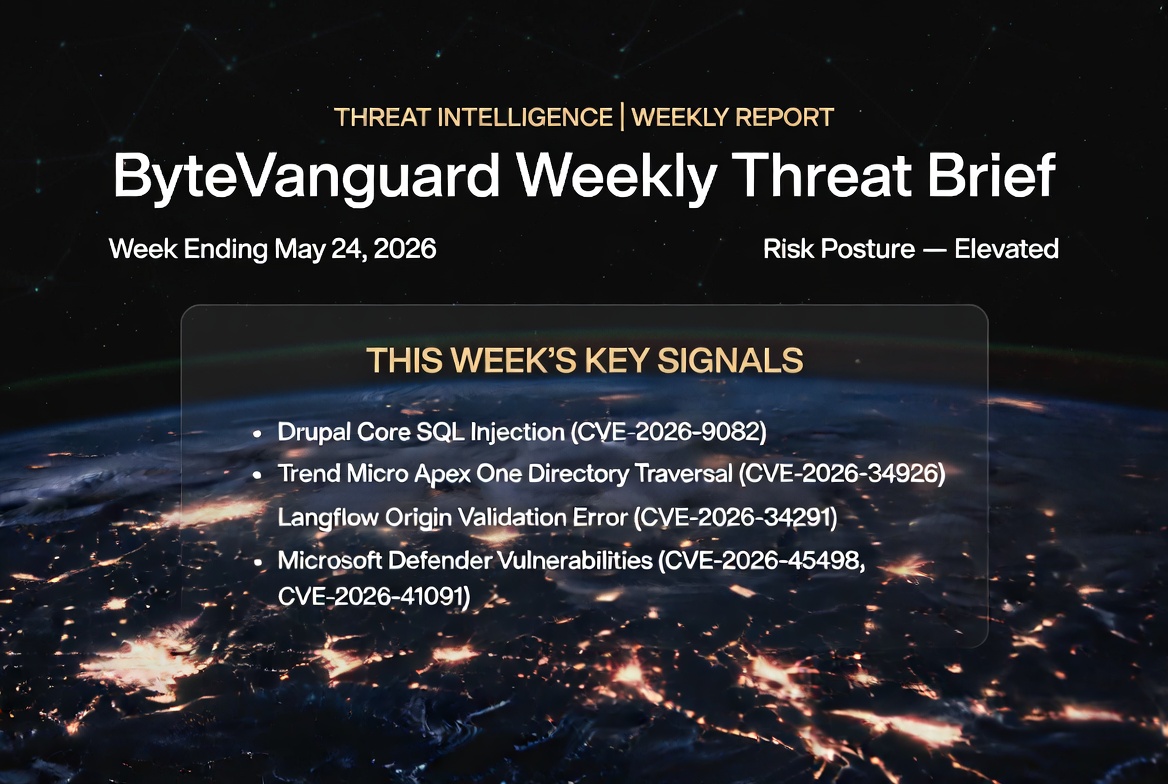
Overall Risk Posture: High
The week ending May 24 was defined by active exploitation across security tooling, enterprise control planes, public-facing web platforms, and emerging AI workflow infrastructure.
The most important signal was not one isolated product flaw. It was the type of technology being pulled into the exploitation window: Microsoft Defender, Trend Micro Apex One, Langflow, Drupal Core, Microsoft Exchange, Cisco SD-WAN, and LiteLLM-related AI gateway infrastructure. These systems sit close to endpoint protection, administration, identity, email, web publishing, automation, and internal APIs.
Threat at a Glance
| Threat Area | Key Issue | Why It Matters | Defender Priority |
|---|---|---|---|
| Microsoft Defender | CVE-2026-41091 and CVE-2026-45498 added to CISA KEV | Endpoint security tooling became part of the active-exploitation story, which makes update verification especially important. | Confirm Defender engine and platform versions across managed endpoints. |
| Trend Micro Apex One | CVE-2026-34926 added to CISA KEV | Endpoint management and protection platforms often have privileged relationships with many devices. | Patch on-premise Apex One and review administrative access to the server. |
| Langflow | CVE-2025-34291 added to CISA KEV | AI workflow platforms are becoming part of the enterprise application attack surface. | Identify exposed Langflow deployments and update affected versions. |
| Drupal Core | CVE-2026-9082 SQL injection added to CISA KEV | Public-facing CMS platforms remain reliable attacker targets, especially when database-layer vulnerabilities are involved. | Patch vulnerable Drupal sites, especially PostgreSQL-backed deployments. |
| Exchange and SD-WAN | Previously reported exploited infrastructure issues remained relevant | Email infrastructure and network control planes continue to offer attackers enterprise leverage. | Continue exposure review, log review, and post-remediation investigation. |
Active Exploitation and Immediate Risk
-
Microsoft Defender became the week’s most uncomfortable signal
On May 20, CISA added two Microsoft Defender vulnerabilities to the Known Exploited Vulnerabilities catalog: CVE-2026-41091 and CVE-2026-45498.
CVE-2026-41091 is an elevation-of-privilege issue tied to Microsoft Defender. CVE-2026-45498 is a denial-of-service issue affecting Microsoft Defender Antimalware Platform. The operational concern is simple: when endpoint protection itself enters KEV, organizations should verify update status directly instead of assuming automatic updates completed everywhere. -
Trend Micro Apex One added another security-tooling concern
On May 21, CISA added CVE-2026-34926 to the KEV catalog. The vulnerability affects Trend Micro Apex One on-premise and is described as a directory traversal issue.
The exploitation conditions are not the same as an unauthenticated internet-facing bug, but the product class matters. Endpoint security and endpoint management systems often sit in privileged positions. If an attacker already has access to the server or administrative path needed to exploit the issue, the impact can extend through the managed environment. -
Langflow showed why AI tooling is now infrastructure
CISA also added CVE-2025-34291 to KEV. The vulnerability affects Langflow, an AI workflow platform, and has been described as a chained issue involving origin validation and token handling that can lead to account takeover and remote code execution in affected deployments.
This is important because AI workflow platforms are increasingly connected to credentials, APIs, internal tools, model gateways, and automation paths. They should be inventoried and patched like normal enterprise applications, not treated as experimental side projects. -
Drupal Core moved from advisory to active-risk priority
On May 22, CISA added CVE-2026-9082 to KEV. Drupal also updated its advisory to reflect that exploit attempts were being detected in the wild.
CVE-2026-9082 is a SQL injection vulnerability in Drupal Core. The issue is especially relevant for PostgreSQL-backed Drupal sites. For public-facing environments, this should be handled as an active-exploitation issue, not a routine CMS update. -
Exchange, SD-WAN, and LiteLLM remained part of the broader risk picture
Microsoft Exchange Server and Cisco Catalyst SD-WAN remained important from the previous week because both sit in high-leverage enterprise positions. Exchange is close to email, sessions, attachments, and business workflows. SD-WAN controllers influence routing, management, and network trust relationships.
LiteLLM also remains relevant as part of the same AI-infrastructure trend. Earlier May activity around CVE-2026-42208 showed that LLM gateways can become valuable targets when they centralize access to model providers, API keys, routing, and internal automation.
Signals to Watch
-
Security tooling is becoming part of the attack surface
Defender and Apex One are not ordinary applications. They are trusted systems that often run with elevated privileges, broad endpoint visibility, and deep operational access. -
AI platforms are entering the KEV conversation
Langflow and LiteLLM show that AI infrastructure is no longer just a research or developer concern. If it is connected to production data, identity, APIs, or internal workflows, it needs normal vulnerability management. -
Public-facing web platforms remain easy targets to operationalize
Drupal Core’s SQL injection issue is a reminder that CMS vulnerabilities can move quickly from advisory to active scanning and exploitation. -
KEV should trigger investigation, not only patching
When a vulnerability lands in CISA KEV, defenders should assume the question has changed from “could this be exploited?” to “was this already tested or used against us?” -
Product class matters as much as the CVE
A medium or high-severity issue in a security platform, control plane, email gateway, or AI gateway may deserve more urgency than a higher-scoring flaw in a lower-value system.
Patch and Mitigation Priorities
- Verify Microsoft Defender engine and platform versions for CVE-2026-41091 and CVE-2026-45498.
- Do not assume Defender automatic updates completed successfully across every endpoint. Confirm status through endpoint management, security console reporting, or direct version checks.
- Patch affected Trend Micro Apex One on-premise systems for CVE-2026-34926 and review administrative access to the Apex One server.
- Identify exposed Langflow deployments and remediate CVE-2025-34291. Pay special attention to deployments reachable from user browsers or connected to internal APIs.
- Patch Drupal Core environments affected by CVE-2026-9082, especially PostgreSQL-backed public-facing sites.
- Review web logs for suspicious Drupal requests, database error patterns, scanning activity, unexpected content changes, or signs of attempted SQL injection.
- Continue reviewing Microsoft Exchange Server exposure for CVE-2026-42897 and Cisco Catalyst SD-WAN exposure for CVE-2026-20182.
- Treat AI gateways, LLM routers, and workflow tools as normal enterprise assets. Assign ownership, track versions, restrict exposure, and include them in patch cycles.
Weekly Pulse
The week ending May 24 produced a clear trust-layer story. Microsoft Defender and Trend Micro Apex One represented security tooling. Langflow and LiteLLM represented AI workflow infrastructure. Drupal represented the public-facing web layer. Exchange and SD-WAN remained examples of communication and network control-plane exposure.
These are different technologies, but they share a common theme: they sit close to systems organizations trust. That is why defenders should prioritize not only by CVSS score, but also by product role, exposure, privilege, and attacker utility.
Bottom Line
This week’s threat picture was shaped by exploitation against systems that defenders, developers, and administrators rely on: endpoint protection, enterprise security platforms, AI workflow tools, CMS infrastructure, email access, and network control planes.
For defenders, the priority is clear: verify Defender updates, patch Apex One and Langflow, remediate Drupal Core quickly, keep pressure on Exchange and SD-WAN exposure, and investigate for signs of access before remediation. KEV is not just a patch list. It is an exploitation signal.
Sources
- CISA — Known Exploited Vulnerabilities Catalog
- CISA — Seven Known Exploited Vulnerabilities Added on May 20
- CISA — Two Known Exploited Vulnerabilities Added on May 21
- CISA — Drupal Core CVE-2026-9082 Added to KEV on May 22
- NVD — CVE-2026-41091 Microsoft Defender Elevation of Privilege
- NVD — CVE-2026-45498 Microsoft Defender Denial of Service
- NVD — CVE-2026-34926 Trend Micro Apex One
- NVD — CVE-2025-34291 Langflow
- Drupal — SA-CORE-2026-004 SQL Injection Advisory
- NVD — CVE-2026-9082 Drupal Core SQL Injection
- NVD — CVE-2026-42208 BerriAI LiteLLM SQL Injection
- Microsoft Exchange Team — Addressing CVE-2026-42897
- Cisco — Catalyst SD-WAN Controller Authentication Bypass Advisory
