

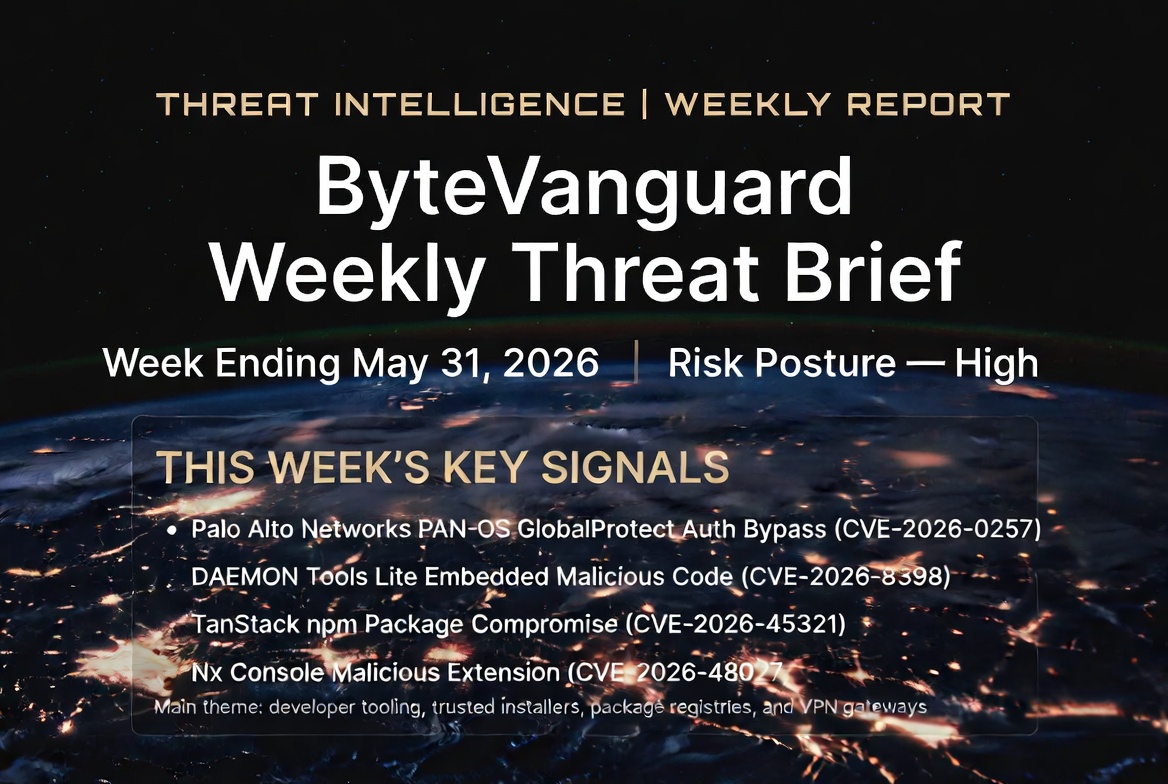
Week Ending: May 31, 2026 | Overall Risk Posture: High
The week ending May 31 was defined by a familiar but uncomfortable pattern: attackers continued to target the systems organizations trust to build, connect, and secure modern environments.
The strongest signals came from developer tooling, software supply chains, GitHub-connected workflows, and VPN security gateways. CISA added exploited vulnerabilities affecting DAEMON Tools Lite, TanStack packages, Nx Console, and Palo Alto Networks PAN-OS to the Known Exploited Vulnerabilities catalog. CISA also warned about supply-chain compromises affecting Nx Console and GitHub repositories.
Not every underlying compromise began last week. Some exposure windows occurred earlier in May or even started in April. But the operational significance changed last week because these issues moved into KEV, public alerts, observed exploitation reporting, or urgent remediation guidance.
Threat at a Glance
| Threat Area | Key Issue | Why It Matters | Defender Priority |
|---|---|---|---|
| Developer Supply Chain | Nx Console, TanStack packages, and GitHub repositories were tied to active supply-chain risk. | Developer tools often touch source code, tokens, package registries, cloud credentials, and CI/CD pipelines. | Inventory affected developer tooling, rotate exposed secrets, and review repository access. |
| Trusted Installers | DAEMON Tools Lite installers were compromised through a supply-chain attack. | Signed or trusted download paths can become malware delivery channels when build or distribution systems are compromised. | Identify affected versions, remove compromised binaries, and investigate endpoints that installed affected packages. |
| VS Code Extensions | A malicious Nx Console extension showed how quickly developer trust can be abused. | Extensions run inside developer environments where source code, SSH keys, npm tokens, cloud keys, and GitHub credentials may be reachable. | Audit installed extensions, restrict extension trust where possible, and monitor for credential access or unusual repository activity. |
| Security Gateways | Palo Alto Networks PAN-OS GlobalProtect authentication bypass was added to KEV. | VPN and security gateways sit at the edge of enterprise access and can become direct paths into trusted environments. | Patch affected PAN-OS and Prisma Access versions and review GlobalProtect exposure. |
| CI/CD and Repositories | CISA warned about supply-chain compromises affecting Nx Console, GitHub repositories, and developer workflows. | CI/CD systems can turn stolen credentials or poisoned automation into repeatable access across repositories and environments. | Review workflows, permissions, OIDC trust relationships, secrets, and recent repository changes. |
Active Exploitation and Immediate Risk
-
Developer supply chains became the week’s dominant risk signal
On May 27, CISA added three supply-chain-related vulnerabilities to the KEV catalog: CVE-2026-8398, CVE-2026-45321, and CVE-2026-48027.
These were not ordinary application bugs. They involved trusted software distribution paths, npm packages, and developer extensions. That changes the defender response. Teams need to ask which developers installed affected tools, which credentials were reachable, which repositories were accessed, and whether build or publishing workflows were exposed. -
DAEMON Tools Lite showed the risk of trusted download paths
CVE-2026-8398 involved a supply-chain compromise affecting DAEMON Tools Lite installation packages. The compromised packages were distributed from the legitimate DAEMON Tools website during an earlier exposure window, affecting Windows versions 12.5.0.2421 through 12.5.0.2434.
This matters because users may have trusted the installer path, the vendor website, or the package signature. For defenders, the response should go beyond removal. Affected endpoints should be reviewed for suspicious child processes, persistence, credential access, and unusual network connections. -
TanStack highlighted package registry and CI/CD trust risk
CVE-2026-45321 involved malicious versions across multiple TanStack packages published to the npm registry on May 11. The reported activity involved the legitimate GitHub Actions OIDC trusted-publisher binding, while the publish workflow itself was not modified.
That detail is important. The risk was not simply “someone uploaded a bad package.” It showed how trusted publishing, workflow execution, and package registry automation can become part of the attack path. Defenders should review lockfiles, package caches, build logs, dependency manifests, and any systems that installed affected package versions. -
Nx Console showed how fast a poisoned developer extension can matter
CVE-2026-48027 involved a malicious Nx Console extension version. The affected version, 18.95.0, was available for a short period on May 19 before removal from extension marketplaces.
Short exposure windows can still create serious risk. Developer extensions run in environments that may have access to source code, GitHub sessions, SSH keys, npm credentials, cloud credentials, and local secrets. The blast radius is not measured only by install count. It is measured by what the affected developer workstation could access. -
CISA warned about supply-chain compromises affecting Nx Console and GitHub repositories
On May 28, CISA warned about emerging supply-chain compromises affecting Nx Console and GitHub repositories. The alert reinforced a broader pattern: attackers are increasingly targeting developer environments, repositories, automation, and code-adjacent workflows.
This is where supply-chain compromise becomes an enterprise security issue. A repository or workflow compromise can expose tokens, alter builds, tamper with releases, or create repeatable access paths into production-adjacent systems. -
Palo Alto Networks PAN-OS brought VPN gateway risk back into focus
On May 29, CVE-2026-0257 was added to CISA KEV. The vulnerability affects Palo Alto Networks PAN-OS GlobalProtect portal and gateway configurations under specific conditions involving authentication override cookies and certificate configuration.
Palo Alto Networks reported limited exploit attempts against unpatched devices without mitigations applied. Rapid7 also reported observed exploitation across customer environments, including suspicious GlobalProtect cookie authentication activity and successful VPN assignment in some cases.
This is high-impact because VPN gateways sit at the edge of enterprise trust. When authentication bypass affects remote-access infrastructure, defenders should prioritize patching, exposure review, mitigation validation, and investigation for suspicious VPN activity.
Common Failure Patterns
-
Trusted tools were treated as low-risk by default
Developer extensions, package managers, GitHub workflows, and vendor installers often receive implicit trust. Attackers are exploiting that trust because these tools sit close to source code, credentials, and deployment paths. -
Short exposure windows still created serious risk
A malicious extension or package does not need to remain available for days to matter. If it reaches the right developer workstation or CI/CD environment, minutes may be enough. -
Asset inventory remains weak for developer environments
Many organizations have better visibility into production servers than into developer machines, local package caches, IDE extensions, temporary build runners, and personal access tokens. -
Secrets remain too close to build systems
Developer environments and CI/CD pipelines often contain GitHub tokens, npm credentials, SSH keys, cloud keys, vault tokens, deployment keys, and service-account credentials. That makes supply-chain intrusions especially valuable. -
Security gateways remain exposed enterprise choke points
PAN-OS GlobalProtect risk fits the same pattern seen across edge devices and remote-access systems: attackers prioritize the infrastructure that sits between the internet and the internal network.
Defender Priorities
-
Patch and investigate Palo Alto Networks PAN-OS exposure
Patch affected PAN-OS and Prisma Access versions for CVE-2026-0257. Review GlobalProtect portal and gateway configurations, authentication override cookie usage, certificate configuration, VPN logs, unusual login activity, and unexpected session creation. -
Apply available PAN-OS mitigations where patching is not immediate
For affected configurations, review Palo Alto Networks guidance around disabling authentication override or using a dedicated certificate for authentication override cookies. Mitigation should be treated as temporary unless the affected version is upgraded. -
Identify affected Nx Console installations
Search developer workstations and extension inventories for Nx Console version 18.95.0. Upgrade to a known-clean version, review affected workstations, and investigate for credential access or suspicious outbound activity. -
Review TanStack package exposure
Check package-lock files, pnpm-lock files, yarn.lock files, CI/CD build logs, local package caches, and artifact histories for affected TanStack package versions. Rebuild from clean dependencies where needed. -
Investigate DAEMON Tools Lite installations
Identify endpoints that installed DAEMON Tools Lite versions 12.5.0.2421 through 12.5.0.2434 during the compromise window. Remove affected binaries and review endpoint telemetry for suspicious child processes, persistence, credential access, or unusual network connections. -
Rotate secrets exposed to developer environments
Prioritize GitHub tokens, npm tokens, SSH keys, cloud credentials, CI/CD secrets, vault tokens, deployment keys, and service-account credentials available on affected systems. -
Review GitHub repositories and workflows
Look for newly added workflows, unexpected workflow permissions, suspicious pull request triggers, changes to OIDC trust relationships, unusual artifact publishing behavior, and unexpected changes to release or package-publishing logic. -
Restrict developer extension trust
Reduce automatic trust in IDE extensions. Maintain an approved extension list, monitor extension versions, and treat developer tooling as part of the enterprise attack surface.
Signals to Watch
-
Developer endpoints are becoming privileged access paths
A developer workstation may hold access to source code, package registries, deployment systems, cloud consoles, and production-adjacent secrets. That makes developer compromise more strategic than ordinary endpoint compromise. -
CI/CD pipelines are now part of the active attack surface
Build workflows, OIDC trust relationships, package publishing permissions, and GitHub Actions are increasingly attractive because they can convert one compromise into repeated access. -
KEV is expanding beyond classic server vulnerabilities
This week’s KEV additions show active exploitation pressure across installers, packages, extensions, and security gateways. Vulnerability management programs need to follow that expansion. -
Security infrastructure remains a target
Palo Alto Networks PAN-OS reinforces a familiar pattern: attackers continue to focus on edge devices, VPN infrastructure, and platforms that control access into enterprise networks. -
Supply-chain response requires more than patching
When a package, installer, or developer extension is compromised, the response must include secret rotation, repository review, developer workstation investigation, and CI/CD audit.
Weekly Pulse
The week ending May 31 produced a clear message: trust is the new exploitation surface.
DAEMON Tools Lite represented trusted installers. TanStack represented package ecosystems and trusted publishing risk. Nx Console represented developer extensions. GitHub repositories and workflows represented code-hosting and automation exposure. Palo Alto Networks PAN-OS represented VPN gateway and edge-access risk.
These are different technologies, but they share one important feature: organizations rely on them to build, connect, deploy, and secure the business. That is exactly why attackers want them.
Bottom Line
This week’s threat picture was shaped by exploitation against trusted systems: developer tools, software packages, official installers, GitHub repositories, CI/CD workflows, and VPN gateways.
For defenders, the priority is clear: patch PAN-OS quickly, identify affected Nx Console installations, review TanStack package exposure, investigate DAEMON Tools Lite installations, audit GitHub repositories and workflows, and rotate secrets that may have been exposed through developer environments.
The larger lesson is that supply-chain compromise is not only an AppSec issue. It is an identity issue, an endpoint issue, a cloud issue, and an enterprise resilience issue.
KEV is not just showing what was vulnerable. It is showing where attackers believe enterprise trust can be turned into access.
Sources
- CISA — Known Exploited Vulnerabilities Catalog
- CISA — Three Known Exploited Vulnerabilities Added on May 27
- CISA — Supply Chain Compromises Impact Nx Console and GitHub Repositories
- CISA — One Known Exploited Vulnerability Added on May 29
- NVD — CVE-2026-8398 DAEMON Tools Lite Supply Chain Compromise
- NVD — CVE-2026-45321 TanStack Package Compromise
- TanStack — npm Supply-Chain Compromise Postmortem
- NVD — CVE-2026-48027 Nx Console Embedded Malicious Code
- Palo Alto Networks — CVE-2026-0257 Security Advisory
- NVD — CVE-2026-0257 PAN-OS GlobalProtect Authentication Bypass
- Rapid7 — Observed Exploitation of PAN-OS GlobalProtect Authentication Bypass
