

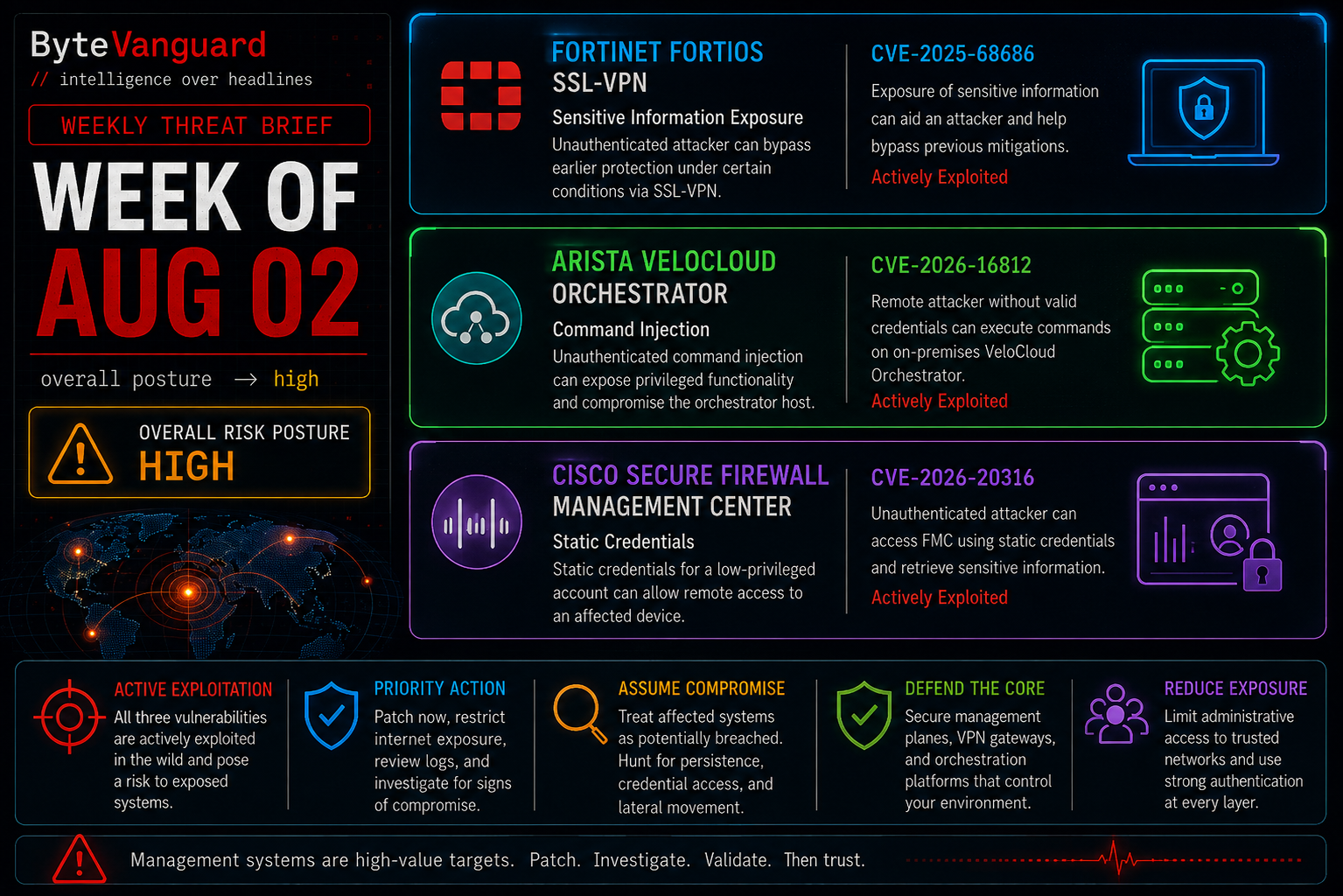
Week Ending: August 2, 2026 | Overall Risk Posture: High
CISA added three vulnerabilities to its Known Exploited Vulnerabilities catalog during the week ending August 2. The affected products are Fortinet FortiOS, Arista VeloCloud Orchestrator, and Cisco Secure Firewall Management Center.
The number of additions is small, but the operational importance is high. All three products sit close to the network control layer. They manage remote access, software-defined connectivity, firewall policy, or security telemetry.
This creates a more serious risk than an ordinary application compromise. An attacker who gains access to a management platform may see sensitive configuration data, weaken defensive controls, reach connected devices, or use trusted administrative channels to move deeper into the environment.
Threat at a Glance
| Product | Exploited Weakness | Defender Priority |
|---|---|---|
| Arista VeloCloud Orchestrator | An unauthenticated command-injection vulnerability can expose privileged internal functionality and compromise the orchestrator host. | Upgrade on-premises deployments immediately, restrict management access, review logs, and investigate the orchestrator as a possible breach point. |
| Cisco Secure Firewall Management Center | Static credentials can allow a remote attacker to access an affected device through a low-privileged account. | Install Cisco’s fixed release or hotfix, check the vendor-provided indicator of compromise, and contact Cisco TAC if exploitation is suspected. |
| Fortinet FortiOS SSL-VPN | A sensitive-information exposure issue can allow an unauthenticated attacker to bypass an earlier protection under certain conditions. | Apply Fortinet’s remediation guidance, review SSL-VPN exposure, and investigate unexpected administrative or configuration activity. |
Active Exploitation
-
Arista VeloCloud Orchestrator command injection
CVE-2026-16812 affects on-premises VeloCloud Orchestrator deployments. The vulnerability can allow a remote attacker without valid tenant or operator credentials to reach internal functionality and execute commands against the orchestrator host.
Arista assigned the issue a maximum CVSS score of 10.0 and confirmed that it is being actively exploited. The affected interface is exposed by default, although restricting access to trusted administrative networks can reduce the reachable attack surface.
The risk extends beyond the orchestrator itself. VeloCloud Orchestrator manages network configuration, device inventory, certificates, credentials, and connected edge devices. A successful compromise may therefore expose both the management platform and the infrastructure it controls. -
Cisco firewall management credentials exposed
CVE-2026-20316 affects Cisco Secure Firewall Management Center Software. Static credentials for a low-privileged account can allow an unauthenticated remote attacker to log in and access sensitive information.
The base score is lower than the Arista vulnerability, but Cisco rated the advisory High because the weakness can be chained with other vulnerabilities to elevate privileges. This distinction matters: severity scores describe a vulnerability in isolation, while attackers often combine several weaknesses to reach a more damaging result.
Cisco has released hotfixes and fixed software. There is no workaround that fully addresses the vulnerability. Cisco also published a specific log indicator that customers can use to identify possible exploitation and recommends contacting its Technical Assistance Center when compromise is suspected. -
Fortinet SSL-VPN persistence risk
CVE-2025-68686 affects Fortinet FortiOS SSL-VPN functionality and concerns exposure of sensitive information to an unauthorized actor.
The vulnerability is associated with a bypass involving an earlier SSL-VPN protection. This makes the issue especially important for organizations that believe a previous update fully removed the underlying exposure.
Remote-access infrastructure remains an attractive target because it is intentionally internet-facing and often provides a trusted entry point into internal networks. Defenders should confirm that every relevant FortiOS appliance received the complete remediation rather than relying only on the presence of an older patch.
The week’s central lesson: a vulnerability does not need the highest severity score to become urgent. Active exploitation, internet exposure, administrative reach, and the ability to chain weaknesses can matter more than the headline number.
The Control Plane Is the Target
These three vulnerabilities are connected by where the affected products sit in the environment. They are not ordinary user applications. They help determine who can connect, how traffic moves, which policies are enforced, and what administrators can see.
-
Remote access creates an external doorway
FortiOS SSL-VPN is designed to accept connections from outside the organization. That business requirement also makes it continuously visible to attackers scanning the internet for vulnerable gateways. -
Orchestrators hold concentrated authority
VeloCloud Orchestrator can influence many distributed devices from one interface. Centralized administration improves efficiency, but it also means one compromised platform may create a large blast radius. -
Security tools are not automatically secure
Cisco Secure Firewall Management Center helps operate defensive infrastructure, but it remains software with accounts, web interfaces, credentials, logs, and vulnerabilities. Its security role makes unauthorized access more valuable, not less likely.
Attackers do not need to disable every defensive product. In many cases, they only need access to the platform that controls those products. From there, they may collect configuration information, alter policy, suppress visibility, create trusted pathways, or prepare a second stage of the attack.
Why Patch-Only Responses Fall Short
Installing the vendor update closes the known vulnerability, but it does not determine whether the system was compromised before remediation. That distinction is critical for internet-facing management platforms.
Organizations should treat the period between initial exploitation and patch installation as a possible intrusion window. Logs, administrative actions, outbound connections, file changes, new accounts, and modifications to managed devices should be reviewed during that period.
The response should also account for what the affected platform could access. A compromised orchestrator may expose certificates or device credentials. A compromised firewall manager may reveal network structure and defensive policy. An SSL-VPN incident may expose authenticated sessions or provide an entry point into internal services.
This is why the correct workflow is not simply patch and close. It is patch, investigate, rotate exposed secrets where necessary, validate connected systems, and then close the incident only when evidence supports that decision.
Defender Priorities
-
Find every affected management interface
Inventory on-premises VeloCloud Orchestrator, Cisco Secure Firewall Management Center, and FortiOS SSL-VPN deployments. Include disaster-recovery systems, lab environments, inherited infrastructure, and appliances managed by external providers. -
Patch according to vendor guidance
Apply the fixed VeloCloud releases, Cisco hotfixes or corrected software, and Fortinet’s complete remediation. Confirm the installed version after maintenance rather than assuming the update succeeded. -
Reduce direct internet exposure
Restrict management interfaces to trusted administrative networks, secure jump hosts, or approved VPN paths. Internet exposure should exist only where it is operationally required. -
Review indicators and administrative activity
Use Cisco’s published detection guidance and examine VeloCloud web, application, system, and database logs. Investigate unexpected logins, configuration changes, maintenance actions, exports, file creation, or outbound traffic. -
Validate the systems under management
Check firewall policies, network objects, administrator accounts, certificates, edge-device state, VPN configuration, and recently modified rules. A clean management server does not automatically prove that connected devices were untouched. -
Rotate credentials based on exposure
Change administrative credentials, API tokens, certificates, service accounts, and other secrets that may have been accessible through a compromised platform. Prioritize credentials that provide access to multiple devices.
Weekly Pulse
This week’s KEV activity is concentrated rather than broad. CISA added only three vulnerabilities, but every affected product operates near a high-trust part of the network.
Arista VeloCloud presents the most direct technical risk because the exploited command-injection flaw can compromise the on-premises orchestrator without valid credentials. Cisco FMC illustrates the danger of vulnerability chaining, where a lower-scored weakness may help unlock a more serious attack. FortiOS shows why defenders must verify that earlier fixes fully removed an exposure.
The broader trend is clear: attackers are targeting the systems that administer security and connectivity. These platforms offer more leverage than a single endpoint because they already possess visibility, authority, and trusted relationships across the environment.
Bottom Line
CISA added three actively exploited vulnerabilities this week affecting Fortinet FortiOS, Arista VeloCloud Orchestrator, and Cisco Secure Firewall Management Center.
Organizations should prioritize exposed VeloCloud deployments, apply Cisco’s FMC hotfixes, verify Fortinet remediation, and investigate whether any of these systems were accessed before the updates were installed.
When attackers compromise the tools that control the network, they do not enter through another endpoint—they gain influence over the infrastructure that decides what every endpoint can reach.
Sources
- CISA — Known Exploited Vulnerabilities Catalog
- CISA — Two KEV Additions, July 27, 2026
- CISA — One KEV Addition, July 29, 2026
- Arista — Security Advisory 0144 for CVE-2026-16812
- Cisco — Secure Firewall Management Center Static Credential Vulnerability
- Fortinet — SSL-VPN Symlink Persistence Patch Bypass
- CVE Program — CVE-2026-16812
- CVE Program — CVE-2026-20316
- CVE Program — CVE-2025-68686
