
Week Ending: August 16, 2026 | Overall Risk Posture: High
August Patch Tuesday delivered the usual wall of vulnerabilities, but only a handful should determine this week’s emergency queue. CISA added three flaws to its Known Exploited Vulnerabilities catalog on August 11: an actively exploited Windows privilege-escalation bug, an unauthenticated SQL-injection flaw in Metabase, and a remotely exploitable denial-of-service weakness in Cisco ASA and FTD VPN infrastructure.
That mix is a useful reminder that vulnerability prioritization is not a severity-ranking exercise. A local Windows bug can be more dangerous than a higher-scoring remote flaw once an attacker already has a foothold. A firewall availability bug matters differently when the vulnerable service is the organization’s remote-access gateway. And a database injection flaw exposed to the internet can turn a business-intelligence application into an entry point.
The practical question this week is not “which CVE has the highest score?” It is “which vulnerability moves the attacker furthest along an attack path?”
Threat at a Glance
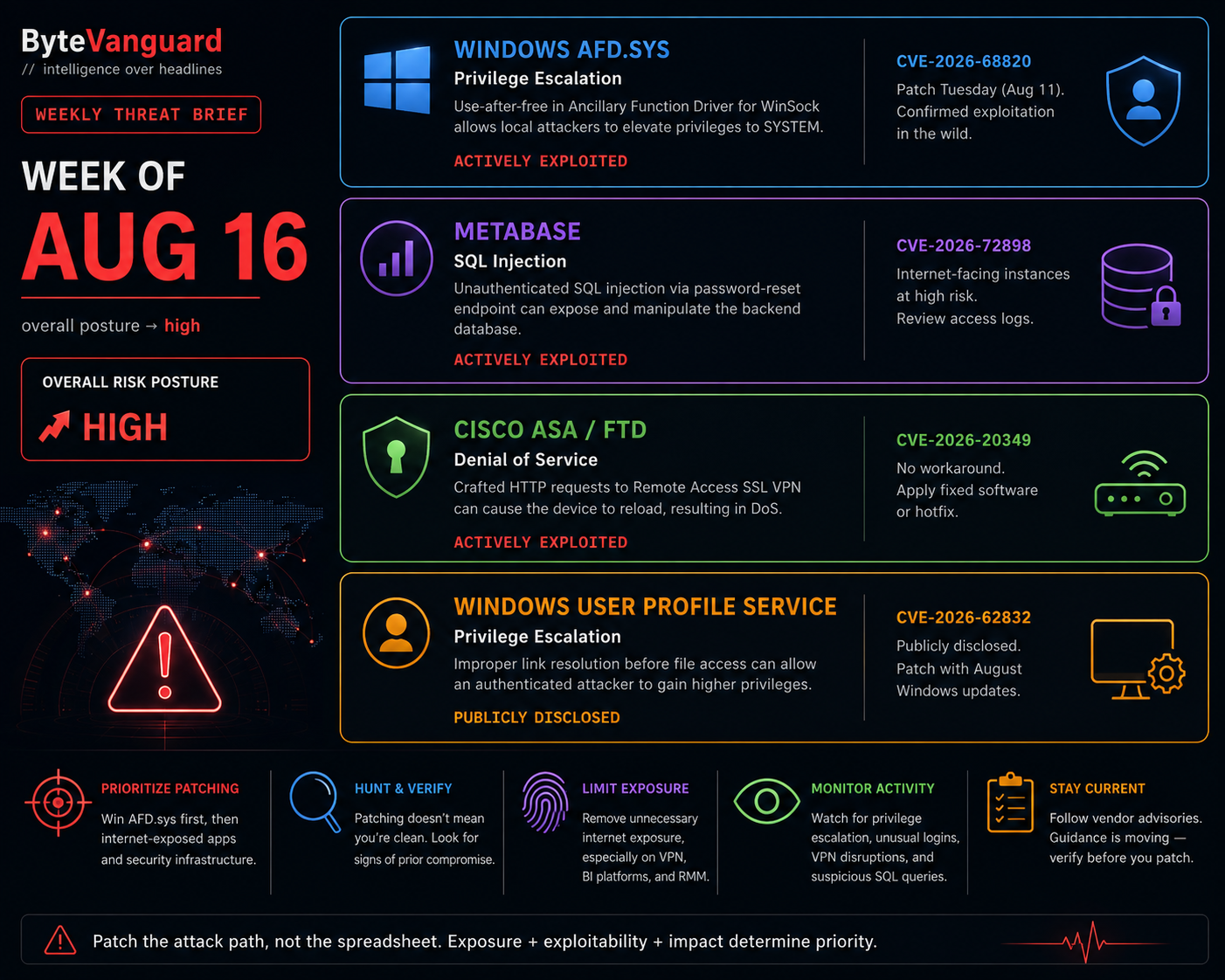
| Product | Exploited Weakness | Defender Priority |
|---|---|---|
| Microsoft Windows | Use-after-free in the Ancillary Function Driver for WinSock allows a local attacker to elevate privileges to SYSTEM. Tied to an active North Korea-linked espionage campaign against defense-sector targets. | Highest priority. Patch Windows endpoints and servers rapidly, then investigate potentially compromised systems rather than treating the update as the end of the incident. |
| Metabase | Unauthenticated SQL injection through the password-reset endpoint can allow an attacker to inject arbitrary SQL into the application’s database workflow. | Patch internet-facing instances first and review access logs for suspicious requests to password-reset functionality. |
| Cisco ASA / FTD | Crafted HTTP requests against Remote Access SSL VPN can cause an affected firewall to reload, producing a denial-of-service condition. | Apply Cisco’s fixed software or hotfix. There is no workaround. Prioritize VPN gateways exposed to the internet. |
| Windows User Profile Service | Publicly disclosed privilege-escalation vulnerability requiring authenticated local access. | Patch with the August Windows updates. Lower priority than confirmed exploitation, but public disclosure shortens the comfortable remediation window. |
Active Exploitation
-
Windows AFD.sys: the foothold-to-SYSTEM vulnerability
CVE-2026-68820 affects the Windows Ancillary Function Driver for WinSock, commonly referred to as AFD.sys. The use-after-free vulnerability can allow an attacker who already has local access to elevate privileges and execute at SYSTEM level.
That prerequisite can make the flaw look less urgent than a remote-code-execution vulnerability. In a real intrusion, the opposite can be true. Initial access increasingly arrives through stolen credentials, phishing, browser exploitation, remote-management tools, or another application vulnerability. Once the attacker is running code with limited rights, a reliable SYSTEM escalation is exactly what turns the foothold into control of the host.
Microsoft patched the flaw on August 11, and CISA added it to KEV the same day based on evidence of exploitation in the wild. Independent reporting has since tied the pre-patch exploitation to a Lazarus Group campaign targeting defense and aerospace workers through fake job offers on LinkedIn, using the escalation to disable security tooling after initial access. That attribution is not part of the CISA or Microsoft advisory language and should be treated as third-party reporting rather than a confirmed vendor finding, but it reinforces why this belongs at the top of the queue: this is not a theoretical local bug, it is one link in an active, targeted intrusion chain. This should sit at the top of the Windows remediation queue regardless of the fact that other Patch Tuesday vulnerabilities carry higher numerical severity scores. -
Metabase: an unauthenticated path into the data layer
CVE-2026-72898 affects Metabase and involves SQL injection through the password-reset endpoint. The CVE record describes a remote, unauthenticated attacker being able to inject arbitrary SQL.
The important word here is unauthenticated. Business-intelligence platforms often sit close to valuable data stores and may hold database connections, saved queries, user information, and internal analytics. A weakness in the application’s database interaction therefore matters beyond the web application itself.
Any internet-accessible Metabase deployment should be inventoried quickly, updated according to the vendor’s current guidance, and reviewed for suspicious requests around the affected endpoint. -
Cisco ASA and FTD: availability is part of the perimeter
CVE-2026-20349 affects the Remote Access SSL VPN service in Cisco Secure Firewall ASA and Secure FTD Software. Cisco says insufficient error checking when processing HTTP requests can let an unauthenticated remote attacker send a crafted request that causes the device to reload.
The result is denial of service rather than code execution, but context matters. If the affected appliance provides remote-access VPN for administrators or employees, taking it offline can become an operational security event rather than a simple availability issue.
Cisco has released fixed software and hotfixes and states that no workaround addresses the vulnerability. CISA added the flaw to KEV on August 11, so exposed VPN infrastructure should not be left waiting for the next routine maintenance cycle.
This week’s prioritization lesson: CVSS tells you how a vulnerability behaves. KEV tells you attackers are actually using it. Exposure tells you whether they can reach it. Asset role tells you what happens next. Good patch prioritization needs all four.
Patch Tuesday and the Attack Path Problem
Microsoft’s August release contained hundreds of security fixes across Windows, Office, SharePoint, Azure components, developer tooling, and other products. Looking at that release as one giant severity-sorted spreadsheet creates an immediate operational problem: almost no security team can treat hundreds of vulnerabilities as simultaneous emergencies.
That spreadsheet also included several unauthenticated remote code execution flaws scored at or near the top of the CVSS scale, including a stack-based buffer overflow in Windows DNS Server (CVE-2026-62878). None of those were flagged as exploited at release, which is precisely the point: a 9.8 sitting unexploited on a server does not automatically outrank a 7.x that attackers are already using. They belong in the same remediation cycle as CVE-2026-68820, just not ahead of it in the emergency queue, and internet-facing DNS servers running an affected build should not wait for a routine cycle either.
CVE-2026-68820 shows why attacker position matters more than raw score. It is a privilege-escalation vulnerability, so it does not normally provide initial access by itself. But an attacker who reached a workstation through phishing or another exploit can use privilege escalation to move from a constrained user context to SYSTEM. From there, credential theft, security-control tampering, persistence, and lateral movement all become easier.
That makes the vulnerability a link in a chain rather than a standalone event:
Initial access → code execution → privilege escalation → credential access → lateral movement
Patch programs that score each vulnerability independently can miss this. The attacker does not need one CVE that does everything. They need several weaknesses that connect.
The same logic applies in the opposite direction to Cisco’s VPN issue. CVE-2026-20349 does not provide remote code execution, but it sits directly on security infrastructure designed to provide remote access. An unauthenticated ability to repeatedly disrupt that service carries more operational weight than the words “denial of service” might suggest in a generic vulnerability report.
Public Doesn’t Mean Exploited — Yet
Another Windows vulnerability worth separating from the confirmed-exploitation story is CVE-2026-62832, an elevation-of-privilege flaw in the Windows User Profile Service.
The vulnerability was publicly known when Microsoft’s August fixes arrived, but it was not classified alongside CVE-2026-68820 as confirmed active exploitation. That distinction is important. “Publicly disclosed” and “exploited in the wild” are not interchangeable labels.
Public disclosure does, however, alter the remediation clock. Once technical details or proof-of-concept information are available, defenders should assume researchers and attackers can study the vulnerability while comparing patched and unpatched systems.
The right response is not to pretend every public CVE has already become a widespread exploit. It is to recognize that the uncertainty window has narrowed.
Defender Priorities
-
Put CVE-2026-68820 at the front of the Windows queue
Deploy the August Windows security updates to affected systems. Prioritize endpoints used by administrators, high-value servers, exposed workloads, and machines where EDR has already recorded suspicious activity. If your organization has any exposure to defense, aerospace, or government-adjacent sectors, also review recent inbound recruiting contact and unusual LinkedIn-sourced attachments as a precaution, given the campaign reporting tied to this CVE. -
Do not confuse patching with incident closure
If a host was exposed while a vulnerability was actively exploited, the patch prevents future use of that specific weakness. It does not remove persistence, stolen credentials, or malware that may already be present. -
Inventory internet-facing Metabase instances
Confirm the current vendor-supported remediation for CVE-2026-72898 and review web logs around password-reset requests. Treat externally exposed analytics platforms as data-access systems, not ordinary websites. -
Patch affected Cisco VPN gateways
Cisco states there is no workaround for CVE-2026-20349. Use Cisco’s advisory and Software Checker to identify the correct fixed build or hotfix for the specific ASA or FTD release in use. -
Don’t skip the unauthenticated critical RCEs while chasing KEV entries
CVE-2026-62878 and the other 9.8-class Windows Server flaws in this release were not exploited at time of writing, but “not yet exploited” is not the same as “not urgent.” Patch internet-facing and Tier-0 servers against these in the same cycle. -
Use attack paths to break Patch Tuesday ties
When ten vulnerabilities all appear urgent, rank the ones that are exploited, internet-accessible, reachable without authentication, useful for privilege escalation, or located on identity and security infrastructure.
Weekly Pulse
CISA added three vulnerabilities to KEV on August 11: Microsoft Windows CVE-2026-68820, Cisco ASA/FTD CVE-2026-20349, and Metabase CVE-2026-72898. They represent three very different attack positions — post-compromise privilege escalation, perimeter availability, and unauthenticated application-layer database access.
Microsoft’s Patch Tuesday release makes the prioritization problem especially visible. Hundreds of fixes landed at once, while only one Windows vulnerability in that release was identified as already exploited in the wild — though several others, including the Windows DNS Server RCE, carried higher raw severity scores and belong in the same patch cycle. CVE-2026-62832 adds a second signal because it was publicly known, but public knowledge should not be presented as confirmed exploitation.
The broader trend is not that severity scores have stopped mattering. It is that severity alone increasingly tells defenders too little about what to patch first.
Bottom Line
This was a Patch Tuesday week, but the actionable list is much smaller than the vulnerability count suggests.
Patch the actively exploited Windows AFD.sys vulnerability first. Fix exposed Metabase deployments. Update affected Cisco VPN gateways where there is no workaround. Then work through the remaining August updates — including the unauthenticated critical RCEs that weren’t yet flagged as exploited — according to exposure, privilege, asset role, and exploitability.
The useful unit of analysis is no longer the individual CVE. It is the route an attacker can build from several of them.
Patch the attack path, not the spreadsheet.
Sources
- CISA — Three Known Exploited Vulnerabilities Added to KEV, August 11, 2026
- CISA — Known Exploited Vulnerabilities Catalog
- Microsoft Security Response Center — CVE-2026-68820
- Microsoft Security Response Center — CVE-2026-62832
- Microsoft Security Response Center — Security Update Guide
- Cisco — ASA and FTD Remote Access SSL VPN Denial of Service Advisory
- CVE Program — CVE-2026-20349
- CVE Program — CVE-2026-72898
- Zero Day Initiative — August 2026 Security Update Review
- Cisco Talos — Microsoft Patch Tuesday for August 2026
- SecurityWeek — Fresh Windows Zero-Day Exploited in North Korean Cyberattacks
- The Hacker News — Microsoft Patches 398 Flaws Including a Windows Driver Zero-Day Under Active Attack
