

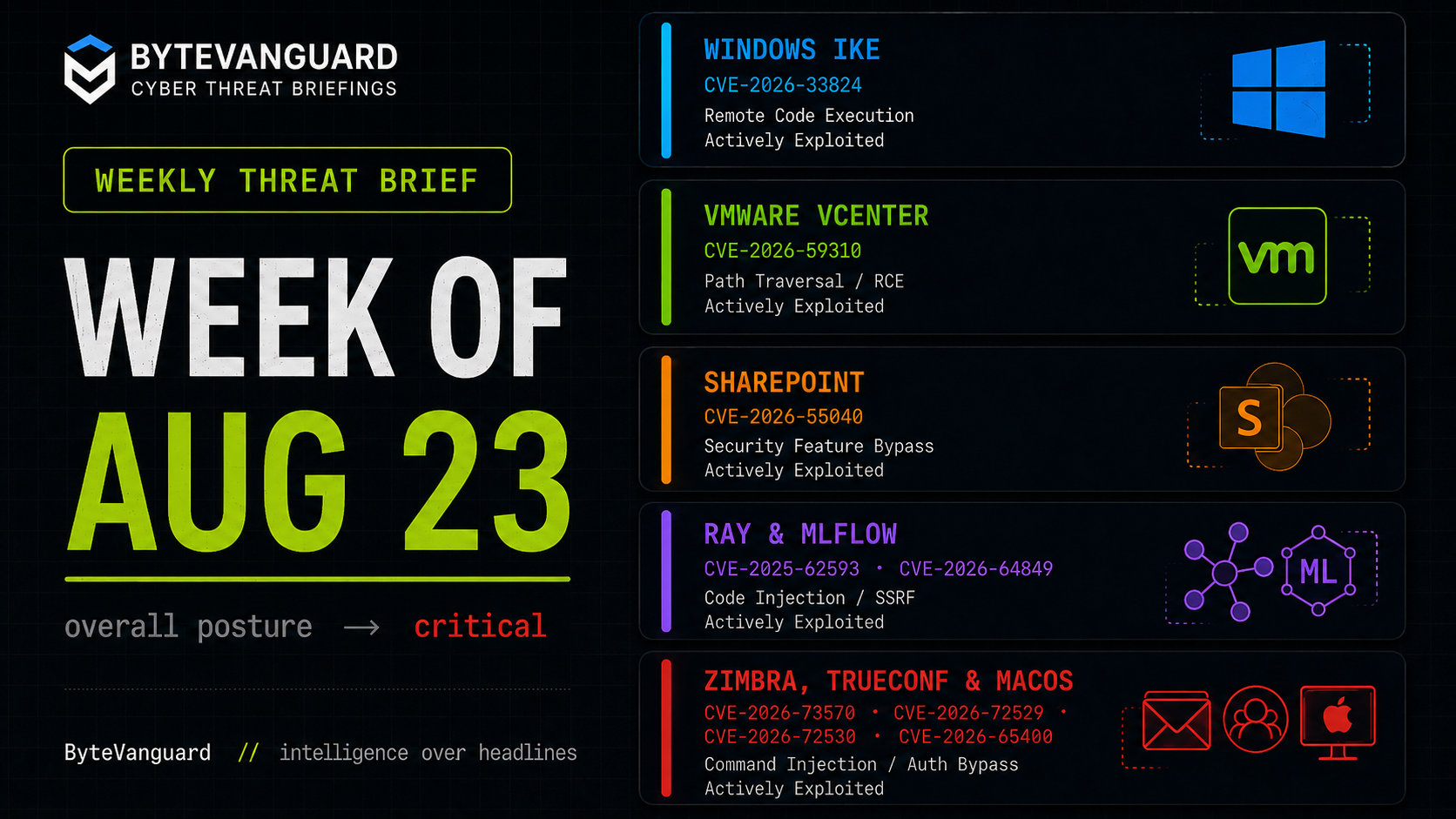
Week Ending: August 23, 2026 | Overall Risk Posture: Critical
CISA added nine vulnerabilities to its Known Exploited Vulnerabilities catalog during the week ending August 23, affecting Windows, SharePoint, VMware vCenter, macOS, Zimbra, TrueConf, Ray, and MLflow.
The products look unrelated. Their position inside modern infrastructure is not. Several provide remote access, control other systems, expose enterprise data, or manage compute workloads. Two sit directly inside the rapidly expanding AI and machine-learning stack.
This week’s signal is less about nine individual CVEs than where attackers are finding leverage: the systems organizations already trust to reach something more valuable.
Threat at a Glance
| Product | KEV | Why It Matters |
|---|---|---|
| Microsoft Windows IKE | CVE-2026-33824 | Unauthenticated remote code execution in a network-facing Windows component. |
| Microsoft SharePoint | CVE-2026-55040 | Security-feature bypass affecting a collaboration platform frequently exposed to the internet. |
| VMware vCenter | CVE-2026-59310 | Compromise of the virtualization management plane can provide leverage over many workloads. |
| Ray | CVE-2025-62593 | Browser-assisted code injection using DNS rebinding can compromise vulnerable Ray developer environments. |
| MLflow | CVE-2026-64849 | SSRF can turn an exposed ML platform into a path toward internal or cloud services. |
| TrueConf / Zimbra / macOS | Four additional KEVs | Exploitation reaches communications, email, and remote-access infrastructure. |
The Highest-Leverage Targets
-
Windows IKE: direct remote entry
CVE-2026-33824 affects Microsoft Windows Internet Key Exchange extensions. The double-free vulnerability can allow an unauthenticated attacker to execute code remotely.
This is the most straightforward emergency case in the week’s list: network reachability, no authentication requirement, and code execution. Systems exposing the vulnerable functionality should move ahead of ordinary patch-cycle scheduling. -
VMware vCenter: the manager is worth more than the server
CVE-2026-59310 affects VMware vCenter. The important issue is not simply that another enterprise application is vulnerable; it is what vCenter controls.
A virtualization-management platform can sit above hundreds of virtual machines and critical workloads. That makes compromise of the management plane fundamentally different from compromise of an ordinary application server. Defenders should patch quickly and review privileged activity rather than relying on remediation status alone. -
SharePoint: exposed collaboration remains a recurring target
CVE-2026-55040 adds another exploited SharePoint weakness to a platform that already combines internet exposure, enterprise authentication, sensitive documents, and trusted internal connectivity.
For on-premises deployments exposed during the exploitation window, the right response is patch plus investigation: review authentication, unexpected processes, persistence, and unusual outbound activity.
The common denominator: Windows IKE can provide entry, SharePoint holds enterprise trust and data, and vCenter controls other systems. Attackers do not value these platforms equally because of their CVSS scores — they value the position each one occupies.
AI Infrastructure Has Joined the KEV Queue
The most strategically interesting entries this week may be Ray and MLflow.
CVE-2025-62593 affects Ray, a distributed computing framework widely used to scale Python and machine-learning workloads. The exploited weakness can use a malicious webpage or advertisement combined with DNS rebinding to reach a developer’s local Ray environment and achieve code execution.
CVE-2026-64849 affects MLflow and involves server-side request forgery. SSRF becomes particularly important in cloud environments because a compromised application may be able to reach internal endpoints or metadata services unavailable directly to an external attacker.
The broader lesson is simple: AI infrastructure is becoming ordinary production infrastructure.
Ray clusters, MLflow servers, model registries, notebooks, vector databases, and orchestration tools can hold credentials, reach cloud resources, access valuable datasets, and execute code. Yet many entered organizations through data-science teams rather than traditional infrastructure teams and may not receive the same exposure reviews applied to VPNs, hypervisors, or database consoles.
That security gap is becoming harder to justify. Once an AI platform controls compute or credentials, it belongs in the privileged-infrastructure inventory.
Communications Infrastructure Is Still an Entry Point
The remaining KEV additions reinforce a familiar pattern around systems designed to communicate outside the network.
TrueConf Server received two KEV entries, CVE-2026-72529 and CVE-2026-72530, involving missing authentication for critical functionality and code injection.
CISA also added CVE-2026-73570 in Zimbra Collaboration Suite, where command injection can expose the underlying operating system, and CVE-2026-65400 affecting macOS Screen Sharing authentication.
Email, conferencing, and remote-access services cannot simply be hidden from every external connection; connectivity is their purpose. That makes authentication, rapid remediation, restricted administrative access, and post-exploitation monitoring especially important.
OT Watch: Siemens S7
Separate from the nine KEV additions, CISA issued guidance during the week around an active threat affecting Siemens S7-series programmable logic controllers.
The distinction matters: this should not be counted as a tenth KEV. It is included here because the consequences move beyond conventional enterprise IT. PLCs can control physical processes, so unauthorized access or logic modification can create operational and potentially safety consequences that ordinary endpoint risk models do not capture.
Organizations operating Siemens environments should follow current CISA and Siemens guidance, restrict access to controllers and engineering systems, maintain strong IT/OT segmentation, and investigate unexpected configuration or logic changes.
Defender Priorities
-
Patch remote-entry paths first
Prioritize exposed Windows IKE, SharePoint, Zimbra, TrueConf, and other internet-reachable affected services. -
Treat vCenter as Tier-0-style infrastructure
Restrict management access and review administrator activity and configuration changes around the exploitation window. -
Inventory Ray and MLflow now
Search cloud accounts, development environments, labs, and data-science infrastructure. Remove unnecessary public exposure rather than relying on patching alone. -
Hunt where exploitation preceded remediation
A successful update closes the vulnerability; it does not remove credentials, persistence, or tooling established before the patch. -
Handle Siemens through the OT process
Coordinate remediation with engineering and operations teams and prioritize segmentation, access control, configuration integrity, and vendor-supported changes.
Weekly Pulse
Nine KEV additions make this a heavier week than the one before it, but the more important development is the expansion of the trusted attack surface.
Traditional high-value infrastructure remains under pressure — Windows network services, SharePoint, virtualization management, email, conferencing, and remote access — while Ray and MLflow show that AI operations are now part of the same exploitation landscape.
The inventory question is changing with it: security teams need to know not only which servers they operate, but which AI and data-science platforms can execute code, hold credentials, or reach internal cloud services.
Bottom Line
This week’s vulnerabilities span operating systems, collaboration, virtualization, communications, and AI, but the defensive lesson is remarkably consistent.
The systems worth protecting first are often the ones that already possess access to other systems. That now includes AI infrastructure alongside the traditional management and collaboration layer.
If a platform can control compute, reach internal services, or carry privileged credentials, treat it like infrastructure — even if your organization still calls it an AI experiment.
Sources
- CISA — Known Exploited Vulnerabilities Catalog
- CVE Program — CVE-2026-33824 (Microsoft Windows IKE)
- CVE Program — CVE-2026-55040 (Microsoft SharePoint)
- CVE Program — CVE-2026-59310 (VMware vCenter)
- CVE Program — CVE-2025-62593 (Ray)
- CVE Program — CVE-2026-64849 (MLflow)
- CVE Program — CVE-2026-72529 (TrueConf)
- CVE Program — CVE-2026-72530 (TrueConf)
- CVE Program — CVE-2026-73570 (Zimbra Collaboration Suite)
- CVE Program — CVE-2026-65400 (Apple macOS)
- CISA — Siemens S7 Series PLC Active Threat Guidance
