
AI Agents and KEV are starting to collide with one of the hardest problems in enterprise security: the patch window is getting smaller.
For years, vulnerability management has depended on a delay: a flaw is disclosed, defenders triage it, attackers study it, exploit code appears, and organizations patch what they can before the risk becomes operational. That model was already under pressure. AI agents may compress it further.
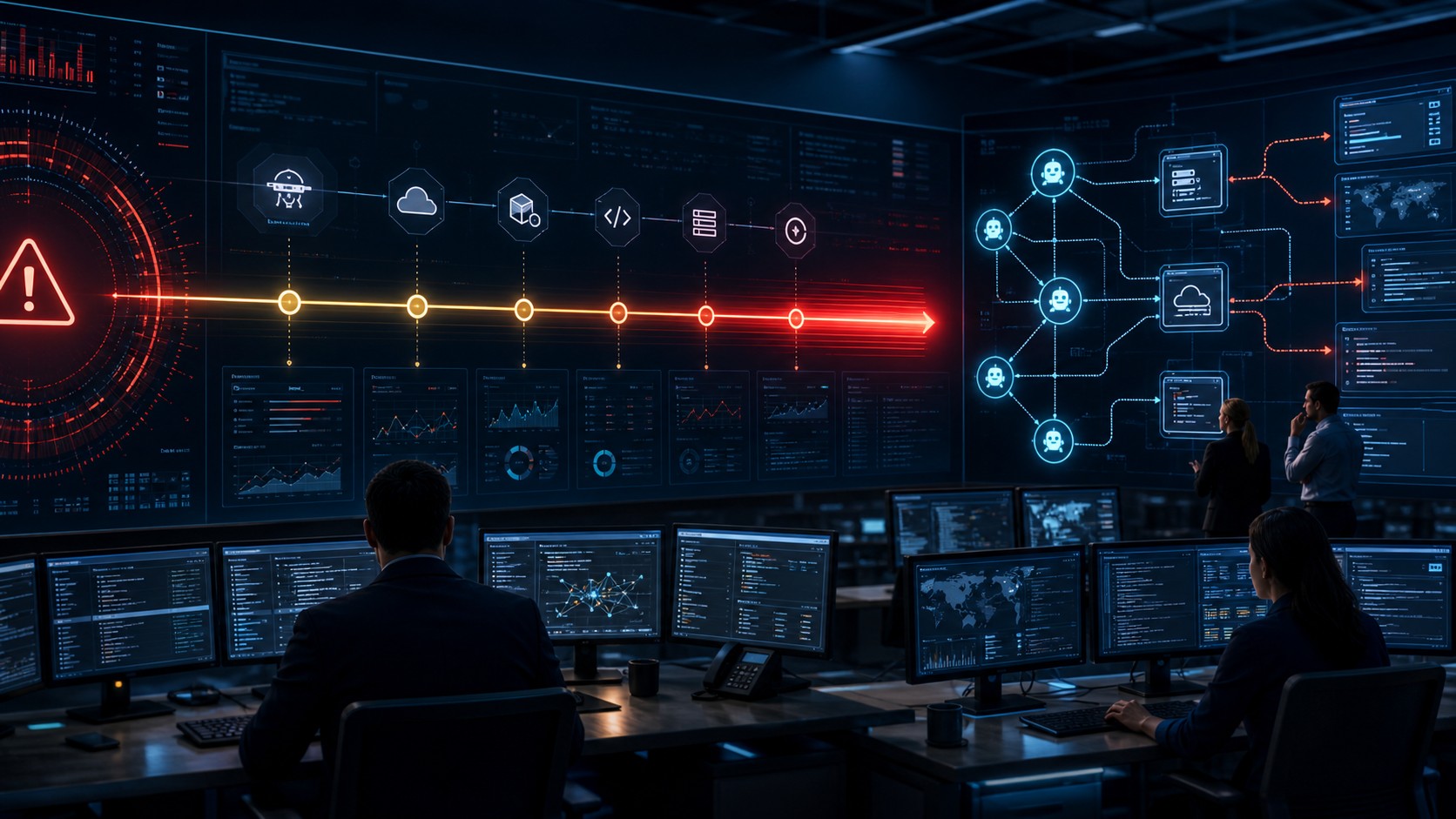
This is where CISA Known Exploited Vulnerabilities and agentic AI now collide. KEV tells defenders which vulnerabilities are already being exploited in the wild. AI agents raise a harder question: how much faster can attackers analyze, adapt, and operationalize those vulnerabilities when automation can assist with scanning, code analysis, exploit modification, and workflow execution?
This article is not about AI magically replacing attackers. The sharper risk is more practical: AI may shorten the time between public vulnerability intelligence and real-world exploitation, while enterprises are also giving AI agents access to code, tools, data, and production workflows.
| Threat Type | AI-assisted vulnerability exploitation and agentic workflow abuse intersecting with actively exploited KEV-listed vulnerabilities |
|---|---|
| Severity | High — not because AI creates new vulnerabilities by itself, but because it can accelerate analysis, exploit adaptation, scanning, and post-exploitation workflows |
| Primary Risk | The time between disclosure, KEV listing, exploit availability, and real-world compromise may continue to shrink |
| Most Exposed Systems | Internet-facing applications, RMM platforms, control panels, VPNs, identity systems, CI/CD pipelines, cloud consoles, and developer environments |
| AI-Agent Risk | Agents can combine reasoning, tool use, file access, code generation, API calls, ticket updates, and workflow execution |
| KEV Relevance | CISA KEV confirms that listed vulnerabilities have evidence of active exploitation and should be treated as priority remediation items |
| Defender Problem | Traditional patch cycles are often measured in weeks; attacker automation may increasingly move in hours or days |
| Primary Control Shift | Patch KEV first, lock down control planes, restrict AI-agent permissions, and require approval before production actions |
| Detection Surface | Vulnerability scanners, internet exposure data, endpoint logs, identity logs, agent tool-call logs, code repository activity, and outbound data movement |
| Business Impact | Faster exploitation can turn delayed patching, weak asset ownership, and over-permissioned automation into enterprise-wide exposure |
The uncomfortable signal this week is that government policy is beginning to reflect a faster exploitation reality.
Reuters reported that U.S. cybersecurity officials are considering much shorter deadlines for fixing critical vulnerabilities in federal systems, potentially reducing some remediation windows from weeks to as little as three days. The reported concern is that AI-powered hacking may reduce the time defenders have to respond once serious vulnerabilities become known.
Even if that proposal changes before it becomes final policy, the direction is clear. The old remediation rhythm is under stress. A two-week or three-week deadline may be too slow for vulnerabilities that are already exploited, internet-facing, easy to scan for, or tied to high-value control planes.
CISA KEV already exists because severity scores alone are not enough. A vulnerability that is being exploited in the wild deserves different treatment from a theoretical vulnerability sitting in a scanner report. KEV is the signal that risk has crossed from possible to operational.
AI does not replace that signal. It makes the signal more urgent.
AI agents are different from normal chatbots because they do not only answer questions. They can take actions.
An AI agent may be connected to source code, internal documentation, cloud consoles, security logs, ticketing systems, deployment workflows, email, file storage, APIs, and command-line tools. That makes the security model very different. A chatbot can produce a risky answer. An agent can make a risky change.
OWASP’s 2026 guidance for agentic applications focuses on autonomous systems that can plan, act, and make decisions across complex workflows. OWASP’s Agentic Skills project also describes the execution layer of agents: the part that gives agents real-world impact through tool use, file access, workflow orchestration, network access, and other capabilities.
That matters for vulnerability management because attackers and defenders may both use similar capabilities.
For defenders, AI agents can help summarize KEV entries, map vulnerable assets, draft remediation tickets, write detection queries, and review patch guidance.
For attackers, AI-assisted workflows may help with vulnerability research, exploit adaptation, reconnaissance, payload modification, log parsing, credential discovery, and chaining together known weaknesses.
The risk is not theoretical “AI magic.” The risk is operational acceleration.
CISA’s Known Exploited Vulnerabilities catalog is one of the clearest prioritization tools defenders have. It does not list every serious vulnerability. It lists vulnerabilities with evidence of exploitation in the wild.
That difference matters.
A critical CVSS score tells defenders that a vulnerability could be serious. A KEV listing tells defenders that exploitation has already been observed. In a world where attacker automation is improving, that distinction becomes more important, not less.
Security teams should stop treating KEV as a weekly reference list and start treating it as an operational queue.
For every KEV entry, defenders should answer:
The last two questions are often where organizations fall short. A ticket marked “complete” is not the same as a verified fix. And patching after exploitation may not remove persistence, stolen credentials, or downstream access.
Recent ByteVanguard coverage has repeatedly returned to the same pattern: attackers are going after systems that administer other systems.
Remote monitoring and management platforms, hosting control panels, VPNs, identity systems, backup consoles, cloud management layers, and CI/CD tools are not ordinary applications. They are control planes. They exist to provide centralized access and privileged control.
That is why KEV-listed vulnerabilities in these systems are especially serious. A compromised control plane can give attackers reach across many downstream assets. The attacker does not need to compromise every system one at a time. The management layer may already have the reach they need.
For recent related coverage, see ScreenConnect in KEV: The RMM Lateral Movement Risk and cPanel Authentication Bypass Added to CISA KEV.
AI agents add another layer to this problem. If an organization connects an agent to a control plane, ticketing system, code repository, cloud console, or deployment process, that agent becomes part of the control surface. It should be governed like a privileged non-human identity, not like a harmless productivity assistant.
Prompt injection is often discussed as a content problem. That framing is too narrow.
In a simple chatbot, prompt injection may cause a bad response. In an AI-agent workflow, prompt injection may influence tool calls, file access, code changes, ticket updates, email actions, or data movement.
That changes the severity. The question is no longer only “Can the model be tricked?” The better question is: “What can the model do if it is tricked?”
If an agent can read sensitive data, process untrusted input, call tools, and send information externally, the organization has created a high-risk path. The model may be the visible layer, but the real issue is permission design.
This is why agentic AI security belongs next to KEV in the same risk conversation. Both are about what can become access.
The AI-agent and KEV intersection is most concerning in environments where vulnerable systems are externally reachable, highly privileged, or connected to automation.
High-risk examples include:
These are the environments where “patch later” becomes dangerous. They are also the environments where over-permissioned AI agents can create new paths for mistakes, misuse, or compromise.
Do not wait for a weekly vulnerability meeting to review KEV additions. KEV-listed vulnerabilities should trigger an immediate asset check.
For each new KEV entry, identify whether the affected product exists in the environment, whether it is externally exposed, whether exploitation attempts are visible, and whether a patch or mitigation can be applied immediately.
Not every vulnerability creates the same blast radius. A vulnerability in a system that administers other systems should receive faster treatment than a similar flaw in a low-impact standalone application.
Place RMM, VPN, identity, cloud management, CI/CD, backup, and hosting control panels into a higher patching tier. These systems should have shorter SLAs, stronger logging, and emergency isolation plans.
Every AI agent with tool access should be inventoried like a service account.
Security teams should know:
If the answer is unclear, the agent is already a governance gap.
Least privilege is necessary, but agentic AI needs something stricter: least action.
An agent should not be able to modify production systems just because it can read production documentation. It should not be able to deploy code just because it can summarize pull requests. It should not be able to email external recipients just because it can analyze internal files.
Separate read permissions from write permissions. Separate analysis from execution. Separate recommendation from approval.
High-risk actions should require human review before execution.
Examples include:
AI can accelerate analysis. It should not silently become the change-control process.
If an agent can touch sensitive systems, its activity should be monitored like privileged user activity.
Useful signals include:
The goal is not to block all automation. The goal is to make automation observable and reversible.
The defender’s job is to connect three layers that are often managed separately: vulnerability exposure, exploitation evidence, and agent permissions.
Vulnerability exposure answers whether the organization has the affected product and whether it is reachable. Internet-facing KEV exposure should be treated as an emergency remediation item, especially when the affected system is a control plane.
Exploitation evidence answers whether the vulnerability may already have been used. Patching is only the first step. Teams should also review logs, authentication events, file changes, new accounts, unusual processes, and signs of persistence.
Agent permissions answer whether AI systems have access to sensitive workflows that could increase blast radius. Agents with access to code, deployment systems, cloud consoles, or ticketing workflows should be reviewed before they become invisible infrastructure.
Most organizations cannot patch everything instantly. That is not a realistic standard. But they can become much better at identifying what cannot wait.
A better prioritization model should weigh:
This is not a replacement for CVSS. It is a more operational layer above CVSS. Severity still matters, but exploitation and exposure should drive urgency.
Enterprise AI security is often framed around data leakage, hallucinations, or prompt injection. Those risks are real, but agentic AI pushes the conversation into a more serious operational space.
When AI agents can access tools, workflows, and production systems, they become part of the enterprise control plane. That means they need identity controls, logging, approval gates, scoped permissions, and incident-response playbooks.
Security teams should ask a direct question:
If this agent is compromised, tricked, or misused, what can it actually do?
If the answer includes production changes, secrets access, broad file access, cloud administration, or external communication, the agent should be treated as a high-risk identity.
AI Agents and KEV now belong in the same security conversation because both point to the same pressure: speed.
CISA KEV tells defenders which vulnerabilities are already being exploited. AI agents may help attackers move faster through the steps that follow: analysis, adaptation, scanning, exploitation, and post-exploitation workflow. At the same time, enterprises are giving their own agents access to code, data, tools, and production processes.
That combination changes the patching conversation.
The next breach may not depend on a new zero-day. It may depend on an old vulnerability, a public exploit path, an exposed control plane, and an automated workflow moving faster than the organization’s remediation process.
For defenders, the answer is not panic. It is prioritization.
Patch KEV first. Lock down control planes. Treat AI agents as privileged non-human identities. Require human approval before production actions. Log every tool call that matters.
Because the patch window is not waiting for the weekly meeting anymore.
If you find ByteVanguard useful, you can support the site and help keep the analysis independent.
Support the analysis