

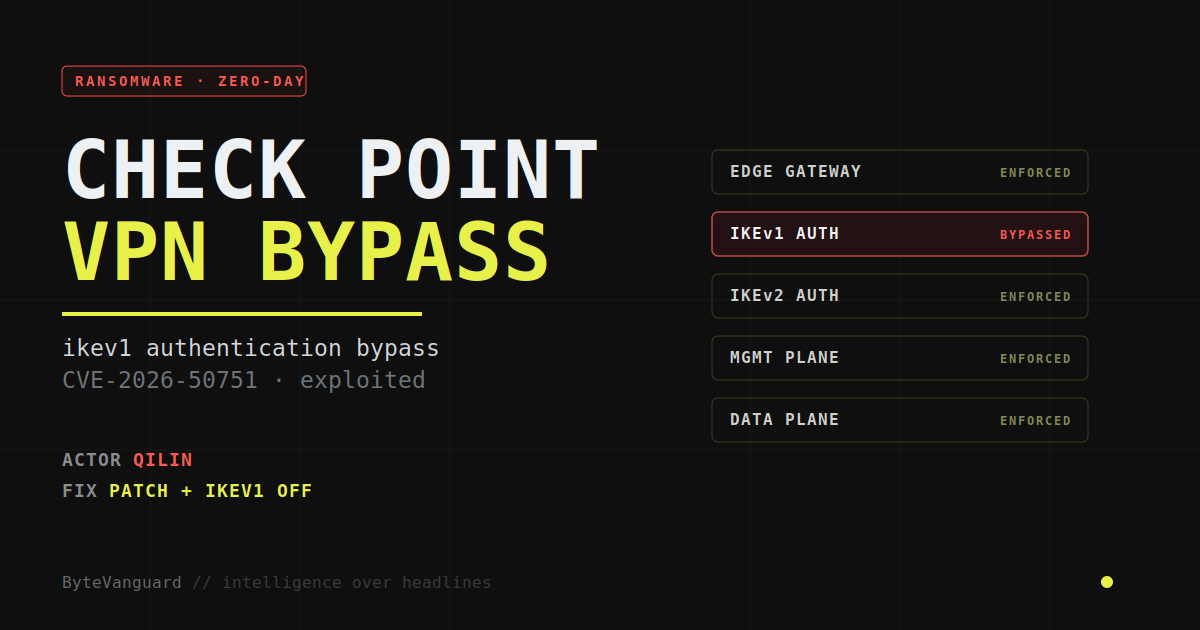
The most prolific ransomware operation of 2026 didn’t need new malware to break into Check Point’s customers. It needed one logic flaw in a VPN protocol that should have been retired years ago — and roughly a month before anyone outside the attacker knew it existed.
On June 8, 2026, Check Point disclosed CVE-2026-50751 — an authentication bypass in its Remote Access VPN and Mobile Access products — and confirmed it was already being exploited in the wild. Buried in the advisory was the detail that matters most: the earliest observed exploitation dates to May 7, 2026. The vulnerability had been a live zero-day for roughly a month before customers had a patch, an advisory, or a CVE number to search for.
In at least one case, the post-compromise activity was attributed — with medium confidence — to an affiliate of Qilin, the ransomware-as-a-service operation that has been the single most active group on the planet for three consecutive quarters. This is the pattern worth internalizing: Qilin’s dominance does not come from exotic tradecraft. It comes from a deep affiliate bench that converts edge-device vulnerabilities into ransomware deployments faster than most organizations can patch. CVE-2026-50751 is the newest door, not a new technique.
Threat at a Glance
| Field | Detail |
|---|---|
| Threat Actor | Qilin (aka Agenda) — RaaS; affiliate-driven. Campaign attribution assessed at MEDIUM confidence by Check Point |
| Operation Type | Ransomware-as-a-Service — Russia-nexus; aggressive affiliate recruitment; Rust-based Windows and Linux/ESXi lockers |
| Primary Entry Vector | Check Point Remote Access / Mobile Access VPN — CVE-2026-50751 (CVSS 9.3), IKEv1 authentication bypass |
| Companion Flaw | CVE-2026-50752 (CVSS 7.4) — IKEv1 certificate-validation MITM on site-to-site VPN. No in-the-wild exploitation observed |
| CISA KEV Status | Listed — “Check Point Security Gateway Improper Authentication Vulnerability”; FCEB remediation due June 11, 2026 (vendor advisory came first) |
| Affected Products | Mobile Access / SSL VPN, Remote Access VPN, Spark firewalls — only where deprecated IKEv1 key exchange is enabled |
| Affected Versions | R80.20.X / R80.40 / R81 / R81.10 (all EOS) · R81.10.X · R81.20 · R82 · R82.00.X · R82.10 |
| Post-Exploit Tooling | Rclone for data exfiltration (per shared hash); Qilin Linux ELF binaries; indicators of Tox protocol for comms |
| Attacker Infrastructure | Dedicated VPS — Kaupo Cloud HK, Shock Hosting, Vultr; in some cases geo-matched to the victim’s region |
| Defender Priority | PATCH NOW — apply the Check Point hotfix (sk185033), or disable the deprecated IKEv1 key exchange |
The edge VPN as Qilin’s front door
Remote-access VPN concentrators occupy the same structural position in an enterprise that RMM consoles occupy in a managed service provider: they are internet-facing, they are trusted by everything behind them, and a single authentication failure on the device hands an attacker a foothold inside the perimeter. That is precisely why edge appliances — Citrix, Fortinet, Ivanti, Palo Alto, F5, and now Check Point — keep appearing at the top of exploited-vulnerability catalogs. They are the most efficient possible entry point, and ransomware affiliates have organized their entire intake pipeline around them.
CVE-2026-50751 is a near-textbook example. The flaw lives in certificate validation logic within Check Point’s deprecated IKEv1 key exchange. By exploiting it, a remote, unauthenticated attacker can establish a remote-access VPN session without ever supplying a valid user password. Check Point is explicit that additional post-authentication activity is required to reach internal resources or escalate privileges — this is a front door, not a full compromise on its own — but for an actor with Qilin’s operational maturity, the front door is the hard part. Everything after it is routine.
The most dangerous interval in any zero-day is the gap between first exploitation and public knowledge. For CVE-2026-50751 that gap was roughly a month — May 7 to June 8 — during which no patch, advisory, or detection signature existed. Incident response teams should treat May 7, 2026 as the start date for any retrospective log review, not the disclosure date.
CVE-2026-50751 and its companion flaw
Check Point’s advisory documents two related vulnerabilities, both rooted in the same deprecated protocol. Only one is being exploited, but both warrant attention because they share an affected footprint.
CVE-2026-50751 is the actively exploited flaw: an authentication bypass affecting Remote Access VPN, Mobile Access / SSL VPN, and Spark firewalls configured to use IKEv1. The certificate-validation logic flow can be manipulated to establish a VPN session without a valid password. Check Point rates it CVSS 9.3 and confirms in-the-wild exploitation.
CVE-2026-50752 is a second flaw surfaced during the same investigation — notably, Check Point credits its own agentic AI code-analysis platform with finding it. It is a certificate-validation weakness in IKEv1 that could, under specific conditions, enable a man-in-the-middle attack against site-to-site VPN communications. It carries a CVSS of 7.4, and Check Point states it has not observed exploitation in the wild. It is a patch-now-anyway item, not an active incident.
The configuration dependency is the single most important caveat for defenders triaging exposure. Neither flaw affects deployments that have moved off IKEv1. This narrows the at-risk population considerably — but legacy key exchange settings are exactly the kind of configuration that survives untouched through years of appliance upgrades, which is why a deprecated protocol can still anchor a 2026 ransomware campaign.
Qilin: the consolidation engine
To understand why a single VPN bug is a serious problem, it helps to understand who is standing behind it. Qilin — tracked since 2022 and also known as Agenda — operates a ransomware-as-a-service model in which a core team maintains the encryptor, leak site, and negotiation infrastructure while affiliates carry out intrusions for a share of the proceeds. The encryptor has evolved from an early Go-based build to a Rust-based locker, with both Windows and Linux/ESXi variants in active use.
What separates Qilin from the field is volume, and the volume is a direct product of ecosystem consolidation. Across 2025 and into 2026, law-enforcement pressure and infrastructure disruption pushed rival operations offline, and their displaced affiliates migrated to the survivors. Qilin was the primary beneficiary, absorbing operators from RansomHub and LockBit as those programs faltered. Check Point’s State of Ransomware report for Q1 2026 placed Qilin first with 338 posted victims — more than the combined output of the bottom fifty groups it tracks — the third consecutive quarter the group held the top position.
“Qilin’s edge is not a better encryptor. It is a larger, more experienced affiliate pool — and that pool turns each new edge-device vulnerability into ransomware deployments at a speed most defenders cannot match.”
— ByteVanguard analysis of Check Point Q1 2026 and CVE-2026-50751 reportingThe group has also professionalized its platform in ways that lower the bar for affiliates. Reporting through 2025 documented in-panel features including a “call a lawyer” option inside the negotiation interface, automated negotiation logic, and built-in data storage so affiliates do not need separate exfiltration hosting. Qilin’s targeting is effectively sector-agnostic — manufacturing has been its most-listed sector, but healthcare exposure has been substantial, and the group’s 2024 attack on the UK pathology provider Synnovis disrupted NHS hospital services and put it on the radar of national-level security and political discourse. An operation this large does not need to be selective.
The attack: what Check Point observed
Check Point launched its investigation on June 4, 2026 after detecting suspicious activity, then traced the campaign back to a May 7 start. The exploitation was not mass-scale — the company describes a few dozen targeted organizations globally — and only one case carried confirmed post-compromise activity tied to a Qilin affiliate. But the tradecraft documented in that case is a clean illustration of how an edge-VPN foothold becomes a ransomware incident.
IKEv1 auth bypass
CVE-2026-50751
Dedicated VPS
Tox indicators
Qilin Linux
ELF download
Rclone → VPS
attacker infra
Qilin ransomware
double extortion
The actor operated from dedicated virtual private server infrastructure rather than compromised hosts, with observed IPs hosted by Kaupo Cloud HK, Shock Hosting, and Vultr. In several instances the geolocation of the attacker’s VPS correlated with the victim’s region — activity against organizations in Taiwan, for example, ran from Taiwan-geolocated infrastructure, a tactic that helps attacker traffic blend with expected access patterns. Check Point also assesses that the same infrastructure is being used to exploit other vendors’ VPN flaws, citing Palo Alto, Fortinet, and F5 — a reminder that this is an access-acquisition operation that does not care which edge vendor it walks through.
Two operational artifacts anchor the Qilin attribution. First, Check Point observed an overlap between Qilin Linux ransomware binaries and attempts to download malicious ELF files from attacker-controlled infrastructure. Second, one of the shared file hashes corresponds to Rclone, the open-source synchronization utility that ransomware affiliates routinely repurpose for bulk data exfiltration ahead of encryption. The presence of indicators pointing to the Tox messaging protocol is consistent with financially motivated ransomware actors. None of this is novel — and that is the point.
What defenders can detect — and when
The challenge with an authentication-bypass flaw is that the initial access generates a session that looks, to most logging, like a legitimate VPN login. There is no failed-auth noise, no brute-force pattern. The detection opportunity therefore shifts to two places: the anomalies in those sessions, and the post-access behavior that a Qilin affiliate must perform to turn a foothold into an incident.
VPN sessions originating from the listed VPS IP ranges or from commercial hosting ASNs (Vultr, Shock Hosting, Kaupo Cloud) rather than residential or expected corporate ranges; remote-access connections that succeed without the expected authentication telemetry; outbound Rclone-pattern transfers to external hosting; and retrieval of unexpected ELF binaries onto Linux or ESXi hosts are all observable before encryption begins.
MITRE ATT&CK coverage
Defender guidance
The priority action is unambiguous and narrow: if you run Check Point Remote Access VPN, Mobile Access, or Spark firewalls with IKEv1 key exchange enabled, you are in the exposed population. Apply the hotfix referenced in Check Point’s advisory, or — where patching cannot happen immediately — disable the deprecated IKEv1 key exchange, which removes the precondition for both flaws.
The broader lesson is one ByteVanguard readers have seen play out across Citrix, F5, Cisco SD-WAN, and ScreenConnect: the edge VPN is Tier-0 infrastructure and deserves Tier-0 scrutiny. A deprecated protocol left enabled on an internet-facing concentrator is not a configuration footnote. It is a ransomware entry point waiting for an affiliate.
The bigger picture: consolidation makes edge bugs more dangerous
There is a tendency to read ransomware-ecosystem consolidation as good news: fewer active groups, fewer names to track. The CVE-2026-50751 campaign shows why the opposite is closer to the truth. When the displaced affiliates of disrupted operations concentrate into a handful of dominant programs, the practical effect is that every new edge-device vulnerability now feeds directly into the intake pipeline of the most capable, best-resourced operators in the market. A flaw that might once have been exploited slowly by a mid-tier group is now exploited quickly, at scale, by the affiliate bench of the year’s most prolific operation.
The other durable lesson is about timing. The exploitation began roughly a month before disclosure. Check Point’s advisory landed first, and CISA added the CVE to its KEV catalog within days, setting a federal remediation deadline of June 11, 2026. That sequence — vendor first, catalog shortly after — is the one to internalize: organizations that wait for KEV synchronization before acting are, by design, a step behind actors who key their operations to the moment a usable bug exists. The defensible posture treats credible vendor-confirmed exploitation as the signal to act, with the KEV listing as confirmation rather than the trigger. Qilin did not find a clever new way in. It found an old protocol that someone forgot to turn off.
References
- Check Point Blog Security Advisory — Active Exploitation of Check Point VPN Authentication Bypass (CVE-2026-50751), June 8, 2026 checkpoint.com ↗
- Check Point Support sk185033 / sk185035 — Affected configurations, mitigation, IOCs, and upgrade guidance support.checkpoint.com ↗
- Help Net Security Qilin Ransomware Affiliate Exploited Check Point VPN Zero-Day (CVE-2026-50751), June 8, 2026 helpnetsecurity.com ↗
- Check Point Research The State of Ransomware — Q1 2026 (Qilin first at 338 posted victims, third consecutive quarter) research.checkpoint.com ↗
- Barracuda Qilin Ransomware Surges Into 2026 — Affiliate Model, Sector Targeting, and Encryptor Evolution barracuda.com ↗
- SOCRadar Dark Web Profile: Qilin (Agenda) Ransomware — Platform Features and Affiliate Operations socradar.io ↗
- The Cyber Express Qilin and INC Ransom Drive 2026 Ransomware Surge — H1 2026 Victim and Sector Data thecyberexpress.com ↗
